

What is Private Duty Nursing Care?

Private duty nursing care is one-to-one, skilled nursing provided on a scheduled or extended basis—usually at home—by a licensed registered nurse (RN) or licensed practical/vocational nurse (LPN/LVN). It is intended for someone who needs more frequent clinical assessment, monitoring or treatment than a visiting nurse can safely provide. This is different from hiring a caregiver to help with bathing, meals or companionship.
For families, the difficult question is often not “Can we get someone to help?” but “Which kind of help is medically appropriate—and what will it cost?” This guide explains who may qualify, what nurses actually do, how private duty nursing compares with home health and personal care, and the steps to take before arranging services.
Quick answer: If a loved one needs nursing judgment or skilled interventions for several hours at a time, discuss private duty nursing with their clinician. If they mainly need assistance with daily routines, a home care aide may be more suitable. If they need only periodic skilled visits, standard home health may be enough. The distinction depends on the person’s actual needs—not simply age, diagnosis or caregiver exhaustion.
Scope: The general care principles can apply broadly, but the insurance, Medicare, Medicaid and dollar figures in this article refer to the United States. Nursing scope-of-practice rules, service availability and funding differ by state and country. This is educational information, not an individual nursing assessment or coverage determination.
What is private duty nursing care?
In U.S. Medicaid regulations, private duty nursing is more individualized and continuous nursing care than a visiting nurse ordinarily provides. In practical terms, a nurse stays with one patient for a defined shift, following medical orders and an individualized care plan. The exact schedule depends on medical necessity, family arrangements, staffing and any approved benefits. See the federal Medicaid definition (42 CFR § 440.80).
“Private duty” does not necessarily mean the family pays privately or that the nurse lives in the house. Medicaid or another insurer may fund eligible care, and a paid shift is not the same as round-the-clock coverage. Some companies use “private duty care” for non-medical caregiving, so always ask whether they mean a licensed nurse providing skilled care or a personal care worker.
What does a private duty nurse do?
A private duty nurse works within their license, training, medical orders and the care plan. Depending on the patient and the nurse’s qualifications, services may include:
- Airway and breathing support: assessing respiratory status and providing ordered tracheostomy, suctioning or ventilator-related care.
- Feeding and nutrition support: administering prescribed tube feedings, checking equipment, and monitoring for concerns.
- Medications and treatments: administering prescribed medications, injections or certain infusions within the permitted scope of practice.
- Clinical assessment: checking relevant vital signs, recognizing changes, documenting findings and contacting the care team when necessary.
- Complex wound, ostomy or catheter care: performing ordered procedures, watching for complications and teaching permitted caregiver tasks.
- Seizure or other condition-specific care: following individualized monitoring and emergency-response plans.
- Family education and care coordination: teaching safe routines, documenting a shift and communicating with the prescribing clinician and other providers.
Not every private duty nurse provides every service. A nurse caring for a child with a ventilator may need very different training from one supporting an adult after a complex hospital discharge. Some tasks can be taught to family members or delegated under applicable rules; other tasks require a licensed professional. The American Academy of Pediatrics describes the different roles involved in complex home care.
Private duty nursing vs. home health vs. a home care aide
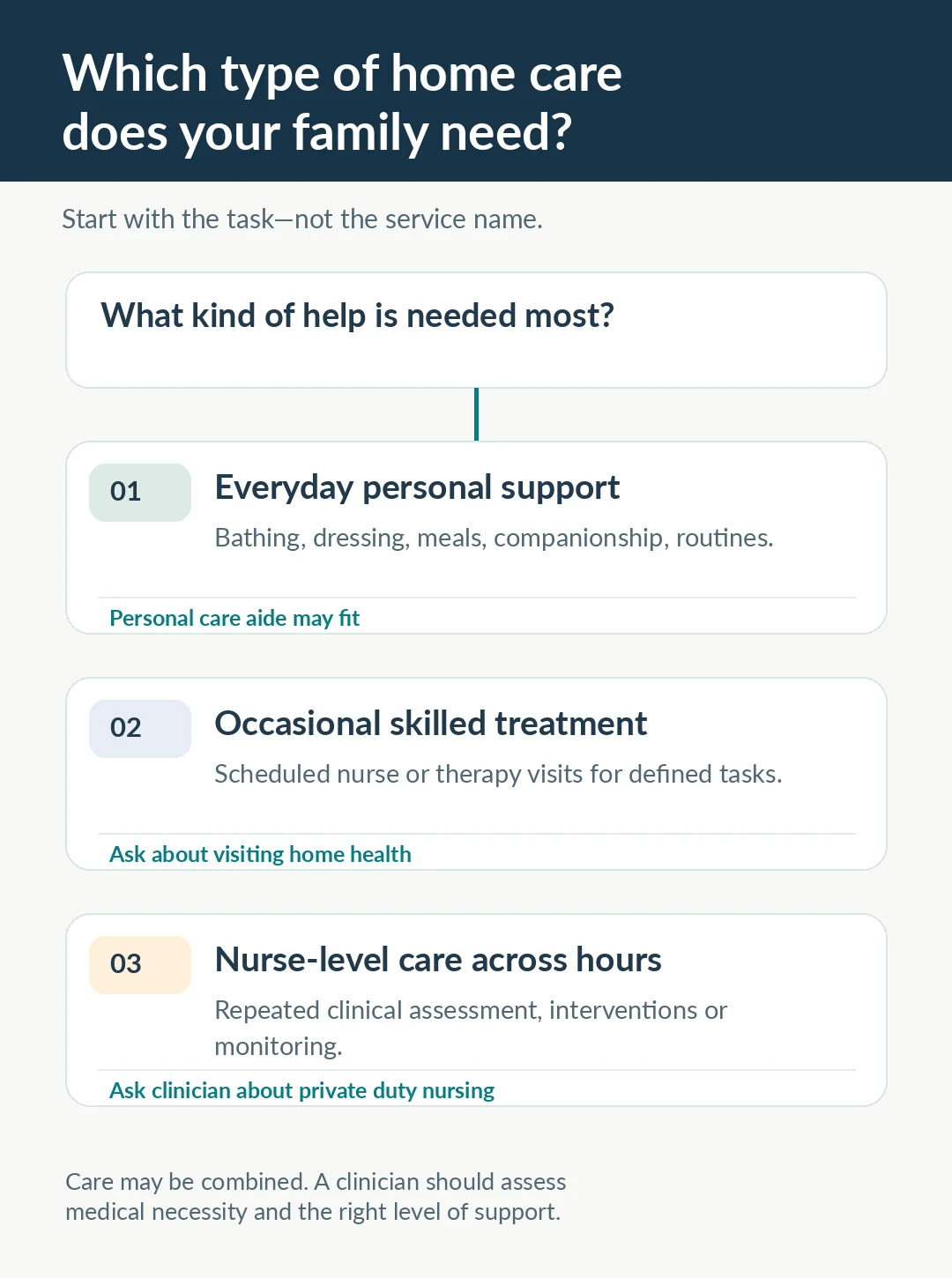
These services may all happen in someone’s home, but they are not interchangeable. The simplest way to understand the difference is to ask whether the person needs help with daily living, occasional skilled treatment or ongoing nurse-level care across a shift.
| Care option | Typical purpose | Who provides it | Common schedule |
|---|---|---|---|
| Personal or companion care | Bathing, dressing, meals, safe movement, supervision, companionship | Home care aide or other qualified caregiver | Hours or shifts, based on daily support needs |
| Visiting home health | Specific skilled nursing or therapy needs that can be managed through visits | Nurses, therapists and other eligible home health staff | Periodic visits under a care plan |
| Private duty nursing | Repeated skilled interventions or clinical observation beyond visiting-care capacity | RN or LPN/LVN within their authorized scope | Extended or regularly scheduled nursing shifts |
Important nuance: An older person with dementia does not automatically need private duty nursing; someone may chiefly need supervision or personal care. Conversely, a child with a tracheostomy or a person with medically complex respiratory needs may need dedicated nursing even though they can engage in many everyday activities. A clinician should assess the actual tasks and risks. For an example of how support needs can change, see our Lewy body dementia guide.
Who may benefit from private duty nursing?
It can be appropriate for children or adults whose needs cannot be handled safely through ordinary caregiver assistance or brief nurse visits. Examples include some people with ventilator or tracheostomy needs, complex feeding or medication regimens, recurring skilled assessments, or complicated conditions following hospital discharge. Having a diagnosis alone does not establish medical necessity.
Three illustrative situations
- A medically complex child: A child at home relies on prescribed respiratory equipment and needs repeated skilled assessment or intervention across the day. A clinician may recommend pediatric private duty nursing and document the necessary hours.
- An adult following a complicated discharge: An adult has multiple high-risk treatments and needs frequent nurse-level monitoring while stabilizing at home. A visiting nurse may not be enough, depending on clinical need.
- An older adult who mainly needs daily assistance: Someone needs help getting dressed, preparing meals and remembering routine appointments but has no ongoing need for skilled nursing observation. A personal care plan may be more appropriate—and less expensive—than continuous nursing.
These are examples, not actual patient histories, and they cannot determine eligibility. The practical test is whether the person needs a licensed nurse present for medically necessary care at the frequency requested.
What happens during a private duty nursing shift?
A shift usually begins with a handoff: the nurse reviews the current care plan, medications, equipment, relevant observations and any changes since the last shift. During the shift, the nurse performs ordered care, documents assessments, communicates concerns and responds according to the escalation plan. A clear handover at the end helps the next nurse or trained caregiver know what happened.
Families should ask what remains their responsibility outside paid nursing hours. Eight hours of nursing does not mean 24 hours of nursing, and an agency’s ability to offer shifts does not guarantee there will always be a replacement. Plan for missed shifts, storms, equipment problems, overnight coverage and emergencies in advance.

How much does private duty nursing cost?
Rates depend on location, RN versus LPN/LVN staffing, the complexity of the assignment, agency arrangements, shift length and timing. The CareScout 2025 Cost of Care Survey, released in 2026, reported a U.S. national median of $90 per hour for private duty nursing and $160 per visit for skilled nursing in the home. These are national survey benchmarks, not a quote and not necessarily what a particular agency will charge.
For perspective, eight hours per day, five days per week at an illustrative $90 hourly rate equals $3,600 per week before any other fees or coverage. Extended schedules can cost considerably more. A family may only need a smaller number of clinically necessary hours, or it may qualify for a program that pays some of the expense. Always request an itemized written estimate, including minimum shifts, holiday premiums, cancellations, supplies, travel, staffing substitutions and rate increases.
Will Medicare, Medicaid or insurance pay?
Original Medicare: visiting home health is not extended private duty nursing
Medicare’s home health benefit can pay for eligible part-time or intermittent skilled nursing and other covered home health services when all program conditions are met. It does not cover 24-hour-a-day care at home, and that benefit should not be mistaken for coverage of ongoing private duty nursing shifts. Ask a Medicare-certified home health agency what services are covered, for how long and what charges you may face.
Medicaid: state rules and age matter
Private duty nursing is listed as an optional Medicaid state-plan benefit for adults, so state benefits, prior authorization and clinical eligibility vary. For many Medicaid-enrolled children under 21, the federal EPSDT benefit can require coverage of medically necessary Medicaid-coverable services, including private duty nursing, even where a state does not otherwise cover that service for adults. Medical documentation and state-specific criteria still matter.
Private plans, long-term care insurance and other programs
Some employer or commercial health plans cover certain skilled home nursing services; others exclude extended private duty nursing or impose strict clinical and prior-authorization rules. Some long-term care insurance policies or veterans’ programs may help with eligible home care, but their terms differ. Do not assume a referral or physician order guarantees payment.
Before booking shifts, ask the payer: Is private duty nursing a covered benefit? Does coverage require an in-network agency? Which clinical criteria and documents apply? How many hours are authorized? Are RN and LPN/LVN rates treated differently? What happens if services are denied, reduced or interrupted? Request the decision in writing and ask about appeal rights.
How to arrange private duty nursing care: seven steps
- Describe the medical tasks. Write down the actual treatments, devices, monitoring needs, timing and what can happen if care is delayed.
- Request a clinical assessment. Speak with the treating clinician or discharge planner about whether continuous/shift nursing, visiting home health or another service fits best.
- Get a written plan of care. Confirm diagnoses, orders, goals, necessary skills, emergency instructions and family responsibilities.
- Check benefits and authorization. Contact Medicaid, the health plan or other payer before scheduling; understand approved hours and any out-of-pocket costs.
- Evaluate agencies and nurses. Verify the nurse’s active state license, relevant skills, agency credentials where required, training and supervision. Use your state nursing board or Nursys QuickConfirm where the state participates.
- Review the staffing plan. Clarify shift assignments, backup coverage, coordination with clinicians and how family members will be trained.
- Review and adjust. Reassess clinical needs, patient preferences, satisfaction, costs and coverage as the situation changes.
Six questions to ask before hiring a private duty nurse
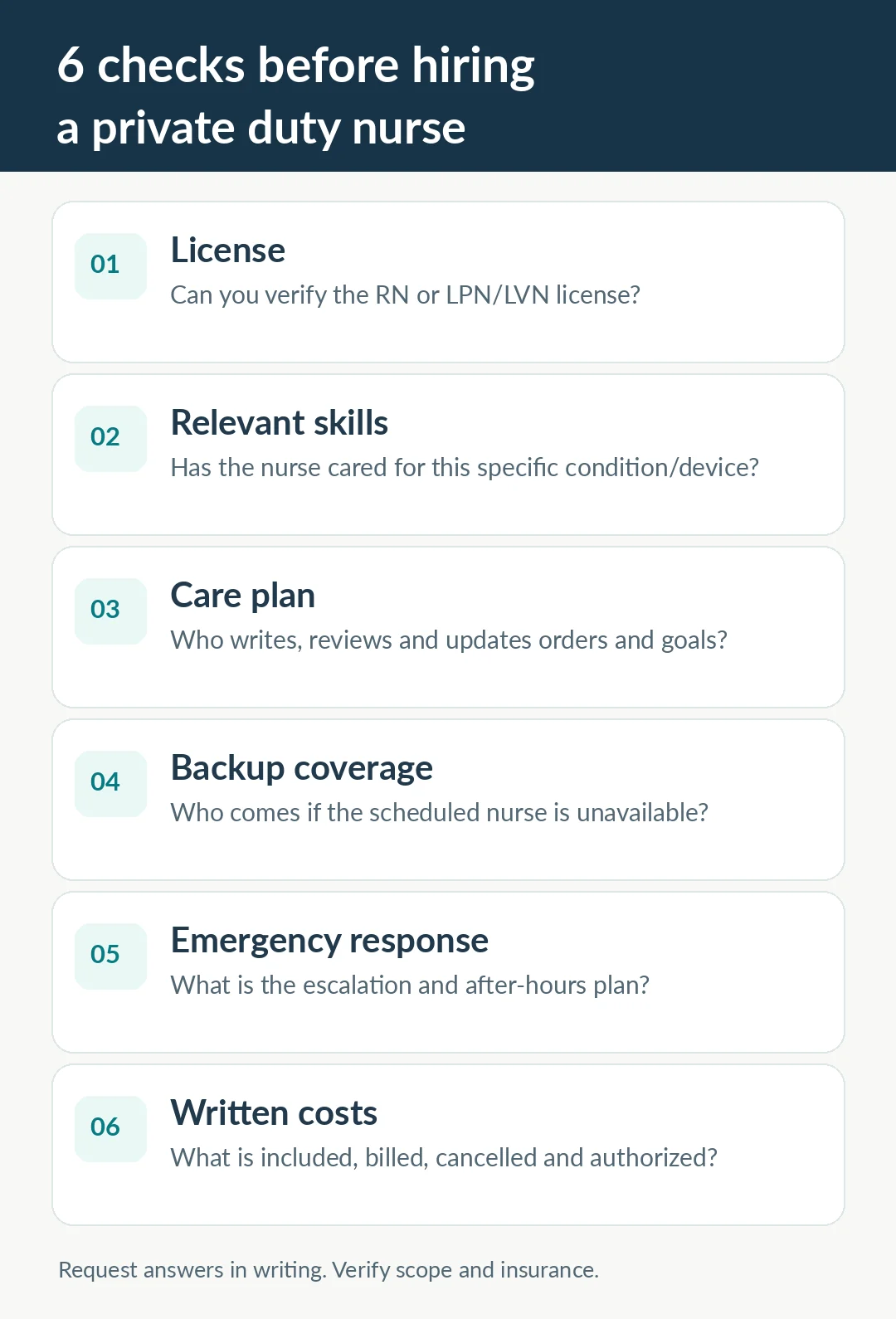
Ask these questions in writing. The answers are more useful than generic promises of “compassionate, round-the-clock care.”
- Licensing: Is the nurse an RN or LPN/LVN, and how can we verify their license and any disciplinary history?
- Clinical fit: What training and recent experience does the nurse have with this exact condition, device or medication?
- Care plan: Who develops, signs, updates and supervises the treatment plan?
- Reliability: What happens when a nurse is absent, and who covers an unfilled shift?
- Safety: Who is called for a changing condition, equipment failure or emergency, including after hours?
- Financial clarity: What will we owe if benefits change, a shift is cancelled or staffing needs increase?
Common mistakes families can avoid
- Hiring by job title alone. “Private care” or “home care” may describe non-medical services, not licensed nursing.
- Choosing nursing solely because someone is older or frail. Get the actual medical need assessed; many families need a combination of personal care and intermittent nursing.
- Assuming 24/7 care is automatic. The written schedule, authorization and backup plan determine real coverage.
- Trusting an insurance estimate without approval. Confirm network status, clinical criteria, authorized hours and personal financial responsibility.
- Overlooking the patient’s preferences. Include the person receiving care wherever possible; discuss privacy, language, routines and who enters their home.
- Skipping contingency planning. Arrange safe steps for missed shifts and equipment problems before care begins.
Frequently asked questions
Is a private duty nurse the same as a home health aide?
No. Private duty nursing involves licensed clinical nursing. A home health aide primarily assists with personal care and other assigned supportive tasks, within applicable training and rules. The two roles can work together.
Can someone receive private duty nursing for only a few hours a day?
Yes. Nursing shifts may be scheduled for portions of the day or longer periods. The right number of hours depends on medical necessity, staffing and any payer authorization; it is not guaranteed to be 24/7.
Does someone with dementia automatically qualify?
No. Dementia by itself does not establish a need for nurse-level care throughout a shift. Some people primarily need supervision and help with activities of daily living; others have complex medical needs that justify skilled nursing. Ask for an individual assessment.
Does Medicare cover a private duty nurse at home?
Original Medicare covers eligible part-time/intermittent home health services, but not 24-hour-a-day home care or routine extended private duty nursing shifts through that benefit. Other insurance or Medicaid rules may be different. See Medicare’s current home health coverage information.
Can a private duty nurse provide hospice care?
A private duty nurse may provide separately arranged skilled support for someone who is also receiving hospice services, but private duty nursing is not a substitute for the hospice team. Medicare hospice has its own levels of care, including short-term continuous home care for qualifying crises; that is not a promise of indefinite 24-hour private nursing. See Medicare hospice levels of care.
What is the first step if we are unsure?
Write down the tasks your family is managing and how often skilled intervention is needed. Bring that list to the treating clinician or discharge planner. Ask which tasks require a nurse, which can be provided by an aide or trained family member, and which services and hours are medically justified. If the discharge follows fracture fixation with a rod, our intramedullary rodding guide offers questions to discuss with the surgical team. For hospital-based observation rather than skilled home nursing, see what a hospital sitter does.
The bottom line
Private duty nursing can make home life possible for people with substantial clinical needs—but it is not a blanket solution for every challenge of aging or caregiving. Start by matching care to the person’s medical needs and preferences. Then check qualifications, coverage, scheduling and a backup plan before making a commitment.
For related reading, see our guides to the duties of a home care aide, caregiver versus caretaker, and rights and choices around nursing home placement.
Sources and further reading
- 42 CFR § 440.80 — Private duty nursing services (federal Medicaid definition).
- Medicare.gov — Home health services (eligibility, limitations and what is not covered).
- Medicaid.gov — Mandatory and optional benefits.
- Medicaid.gov — EPSDT benefit for people under 21.
- CareScout — 2025 Cost of Care Survey results (released 2026; national median benchmarks).
- Nursys QuickConfirm — nurse license lookup (participating jurisdictions).
- Medicare.gov — Hospice levels of care.
Editorial transparency: Fairways Cottage publishes educational guides and does not present itself as a nursing agency or claim that this article was written from direct clinical case experience. Please consult a licensed clinician and your insurer for decisions about care and payment. This article has not been independently medically reviewed.
Share This Article: