

What Does a Hospital Sitter Do?

A hospital sitter—also called a patient sitter, patient safety attendant, one-to-one observer or companion, depending on the hospital—is a person assigned to remain with a patient who needs closer observation, reassurance or safety support. Their core job is to watch, communicate and summon the clinical team when help is needed. They are not a replacement for the patient’s registered nurse, a physician, or a licensed private-duty nurse.
A sitter may be employed by the hospital, supplied by an approved agency, or—in some facilities—be a family-hired companion. The hospital must approve the arrangement and define what the sitter may do. Roles, training, supervision and pricing differ between facilities and countries. A sitter’s presence does not guarantee that falls or other complications cannot occur. Our guide to caregiver and caretaker roles explains why job titles alone do not establish qualifications.
What does a hospital sitter do during a shift?
The specific assignment comes from the hospital’s care plan, not from a generic list on a job website. Common tasks include maintaining required observation, offering calm conversation, noticing attempts to stand without assistance, alerting staff to distress, helping the patient use the call button and handing over safety information to the next worker. Some trained attendants may assist with personal care under supervision; others are observers only.
The Pennsylvania Patient Safety Authority’s review of sitter programs describes variation in sitter training and emphasizes clear roles. Research on hospital sitters has also found that maintaining observation and communicating risk are central duties, although actual practices differ across health systems.
| A sitter may do when authorized | A sitter must not assume they can do |
|---|---|
| Remain within the designated observation area | Leave a patient requiring continuous observation without approved relief |
| Speak calmly, orient and reassure | Diagnose delirium, interpret monitors or decide treatment |
| Notice a patient trying to leave bed or pull lines and summon help | Restrain, lift or physically transfer the patient without the training and direction required by policy |
| Report a new change to the assigned nurse promptly | Administer or change medications or medical devices without appropriate license and authorization |
| Help with simple comfort requests approved by the nurse | Offer food or fluids where swallowing or fasting restrictions are unknown |
| Give structured handover to incoming observer | Substitute a family member for an approved sitter without the hospital’s consent |
Why might a patient need one-to-one observation?
Fall risk, confusion and wandering
A patient recovering from surgery may suddenly try to get out of bed. Someone with dementia or delirium may not recognize the hospital environment. A sitter can notice movement early, call the nurse and help reduce unattended risk. Observation adds a layer of safety; it does not replace clinical fall-prevention measures. For families dealing with a fracture repaired by a rod, see our intramedullary rodding recovery guide for discharge-planning questions. Our Lewy body dementia guide explains why changes in alertness and support needs warrant individual assessment.

Risk of interfering with treatment
A patient who is disoriented may reach for a tube, catheter or dressing. The observer should use the communication and redirection techniques taught by the clinical team and summon qualified staff. They should not improvise hands-on medical interventions.
Emotional distress or a defined behavioral-health risk
Some hospitals use specially trained observers for a person at risk of self-harm, elopement or serious agitation. These assignments require an explicit safety plan and appropriate staffing; an ordinary privately hired companion may not meet that need. Escalating distress should be reported immediately.
Serious illness and family reassurance
A companion can sometimes provide reassuring company during long hospital stays, including palliative or end-of-life care. But a sitter is not automatically part of hospice and does not replace symptom assessment, nursing or family discussions. See our guide to private-duty nursing care for a different type of one-to-one service.
Three things families should see—not just be told
1. The sitter knows how to summon help
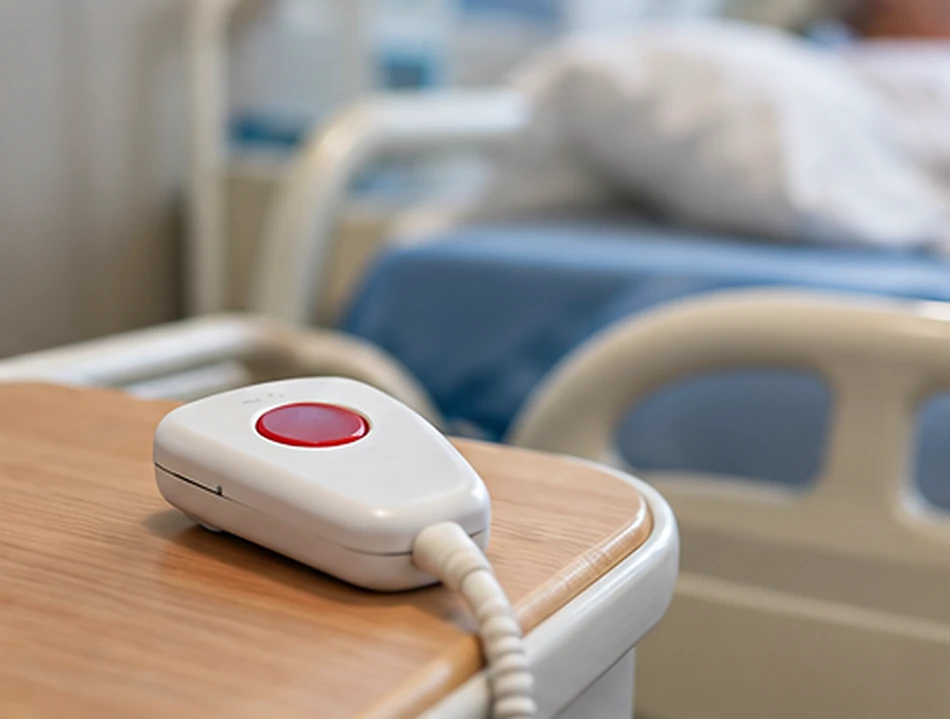
Before the shift, the nurse should clarify whom to call and when. Is the call bell accessible? Does the observer need to remain within arm’s reach or simply keep the patient in sight? What should happen if the patient attempts to stand? These details belong in the individualized plan. The illustration below emphasizes a reachable call system; it is not a clinical instruction to rely solely on a call button for a high-risk patient.
2. The sitter has a defined scope and supervision
Ask who employed the sitter, what training was completed, who supervises the person and which tasks are actually permitted. A hospital employee described as a patient safety attendant may have a different scope from a companion hired privately. An assistant’s ability to take vital signs or help with toileting is policy-dependent—not an automatic part of every sitter role.
3. There is a real handoff when shifts change
For continuous observation, someone must be responsible for coverage during meals, bathroom breaks and shift changes. The incoming worker needs the relevant safety precautions, the escalation plan and any recent changes. Handoffs require a clear exchange of observations and confirmation that another appropriately assigned person has taken over. They must follow the hospital’s documented procedure, not an informal assumption that a visitor or companion will take over.
Hospital sitter vs nurse vs private companion
| Role | Main purpose | Clinical authority | How to arrange |
|---|---|---|---|
| Hospital-assigned sitter or safety observer | Continuous or targeted observation under a defined plan | Limited to hospital policy, training and delegation | Ask the bedside nurse or charge nurse for assessment |
| Registered nurse | Assess, plan, deliver and evaluate nursing care | Works within professional licensure and hospital policy | Part of the hospital’s clinical team |
| Privately hired companion | Company, reassurance and agreed nonclinical support | Usually none beyond tasks specifically permitted by hospital policy | Obtain written hospital approval first |
| Private-duty licensed nurse | Individualized skilled nursing when clinically indicated | Licensed nursing scope, orders and policy | Discuss medical need, hospital approval, credentials and payment |
Do not assume that private payment buys permission to perform additional duties. The Fairways Cottage guide to home care aide duties covers another role that is often confused with hospital-based observation.
How do you request a hospital sitter?
- Explain the actual problem to the patient’s nurse: recent falls, trying to get out of bed, pulling lines, significant anxiety, wandering or changes in behavior.
- Ask for a clinical safety assessment, not simply “a sitter.” The team may recommend observation, delirium evaluation, medication review, toileting schedules, a better room location or other measures.
- Clarify who assigns the sitter and for how long. Availability can vary by staffing and clinical criteria; family preference alone may not establish eligibility.
- If considering private help, ask permission first. Ask about approved agencies, identification checks, infection control, visiting hours and whether private companions may remain overnight.
- Confirm the written boundaries. Who may feed, mobilize or accompany the person? What are the restrictions concerning food and fluids, privacy, devices and photography?
- Review the plan daily. A patient’s observation needs can change, particularly after surgery, medication adjustments or resolution of delirium.
The Nova Scotia Health patient-sitter policy is one example of a formal, institution-specific policy; it is not a universal rule for all hospitals.
How much does a hospital sitter cost?
There is no reliable worldwide hourly price. A hospital-provided, clinically indicated sitter may be staffed and funded differently from a privately arranged companion; insurance and hospital charges differ substantially by location and arrangement. Ask the hospital whether the service is supplied by its staff, covered under the admission, billed separately or available only through an approved private agency. If hiring someone privately, get written details of shift length, overnight charges, cancellations, relief coverage and taxes. Do not use an unverified price estimate as your budget.
A practical handoff checklist for families
For every approved sitter arrangement, keep a short, current handoff with the nurse. It might include:
- The patient’s preferred name, hearing aids, glasses and communication needs.
- Known triggers for distress and reassuring phrases that work.
- Whether they are allowed out of bed independently and what the nurse says to do if they try.
- Whether they may eat or drink and whether swallowing precautions apply.
- Any immediate equipment, lines, mobility or infection-control precautions.
- Who to call first for agitation, pain, chest symptoms, breathing changes or a fall.
- The name of the person covering the sitter’s breaks and the required shift handoff.
This checklist is a discussion aid, not permission for the family or sitter to override clinical orders.
When to alert the nurse immediately
Tell staff promptly about sudden confusion or unusual drowsiness, escalating agitation, a fall or near-fall, attempts to remove important devices, breathing difficulty, chest pain, new weakness, choking or any concerning change. For an emergency, activate the hospital’s emergency response system as directed. Do not delay a call while trying to diagnose the cause.
New confusion in an older inpatient can be delirium and may be caused or worsened by illness, medications, dehydration or other factors. It deserves assessment, not a label of “difficult behavior.” A study of patient sitters in an acute hospital discusses how observers are used with disorientation, agitation and safety concerns, while also noting that practices are not standardized everywhere.
Seven questions to ask before paying for a private sitter
- Does this hospital permit outside companions in this ward and for this patient’s care plan?
- Will the person be an observer only, or is any basic care authorized?
- What background checks, training, vaccinations or hospital onboarding are required?
- Who supervises the sitter, and what happens if they report an emergency?
- Who covers meal and restroom breaks so there is no unsafe gap?
- What is the total cost of a shift, including any minimum hours and cancellation fees?
- How will the sitter communicate with the nursing team without disclosing private patient information improperly?
Frequently asked questions
Is a hospital sitter the same as a nurse?
No. Some sitters may already be nursing assistants or other trained staff, but the sitter assignment itself does not grant a nursing license. Tasks depend on credentials, hospital policy and the patient’s plan.
Can a sitter stop a confused person from falling?
A trained observer can notice warning behavior and call for assistance, but no sitter can guarantee prevention. Hospitals should combine observation with an individualized fall-prevention and delirium-management plan.
Can the sitter feed or give water to the patient?
Only if the hospital authorizes it and the person’s care plan permits it. Patients may be fasting before a procedure or may have a swallowing problem; never assume food or water is safe.
Can a family member act as the sitter?
Some hospitals involve family members in observation or comfort, but arrangements depend on the patient’s needs and local policy. Family presence should not silently replace a medically ordered observer or relieve the hospital of its clinical duties.
Does a sitter stay for the whole night?
Sometimes, if the hospital authorizes a continuous or overnight assignment and staffing allows it. Specify the required hours and break coverage rather than assuming someone will be present continuously.
What if the hospital refuses to provide a sitter?
Ask the charge nurse to explain the risk assessment and alternative safety measures. If danger remains inadequately addressed, request review by the clinical team or patient advocate and discuss whether an approved private companion is appropriate.
Bottom line
A hospital sitter’s most valuable contribution is not a medical procedure; it is reliable observation, timely communication and humane reassurance within a clear safety plan. The right questions are who needs close observation, which responsibilities are permitted and how the sitter and clinical team will respond to a change—not simply whether a chair is occupied beside the bed.
Editorial note: General educational information prepared by Fairways Cottage; not individualized clinical advice or a claim of independent medical review. Hospital policies, worker credentials, costs and emergency procedures vary by location and facility.
Share This Article: