

How Long After Death is a Funeral

Losing someone can leave you needing to make practical decisions before you have had time to process what happened. One of the first questions is often: How long after death is a funeral?
The short answer: In the United States, a funeral with the body present is commonly arranged within about 3–7 days after death. In the United Kingdom, 1–2 weeks is a commonly cited timeframe. Neither range is a universal rule. A funeral may happen sooner for religious reasons, later because of a medical investigation or family travel, or much later if a separate memorial is held after burial or cremation.
The most important detail is where the death happened and what kind of service you are planning. Local laws, documents, religious practices, body care, and the availability of the cemetery or crematorium can all affect the date.
If you are arranging a funeral right now: Contact the hospital’s bereavement team, hospice service, or the appropriate local authority to find out who can authorize release of the person who died. Then speak with a funeral director or the care provider you intend to use. You can discuss possible dates immediately, but do not make non-refundable bookings until the necessary release and permissions are confirmed. If you are preparing in advance with a loved one in hospice, our guide to questions to ask hospice providers includes planning and support considerations.
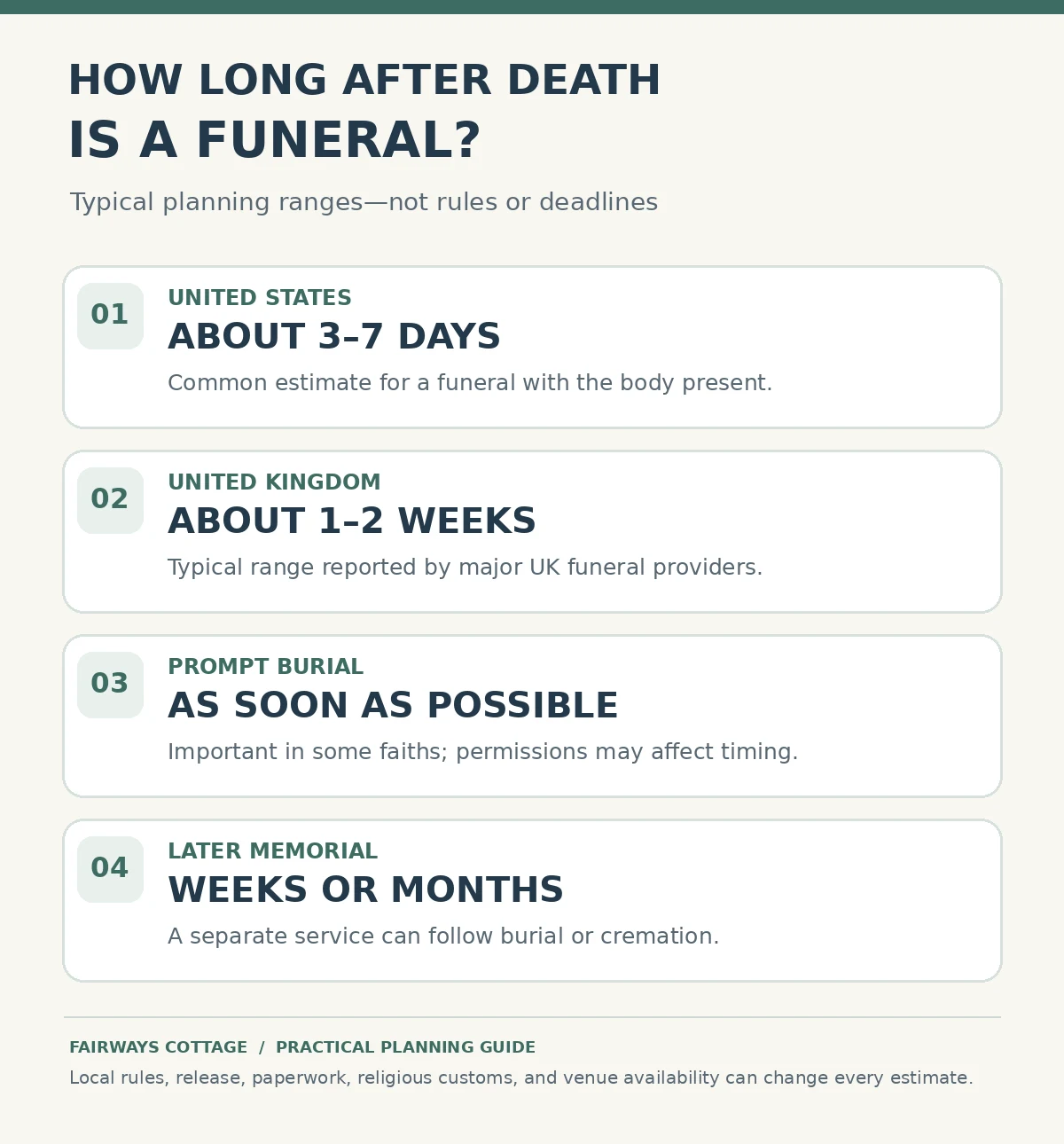
How Long After Death Is a Funeral Usually Held?
The most helpful answer is a range, not an exact number of days. The following are practical planning patterns, not guarantees or nationwide legal deadlines.
| Situation | Common planning window | What to know |
|---|---|---|
| Traditional funeral in the United States | About 3–7 days | The date depends on paperwork, availability, travel, and whether the body will be present. |
| Funeral in the United Kingdom | Often 1–2 weeks | Registration, local capacity, and any coroner involvement can shift the date. |
| Jewish or Muslim burial | As soon as reasonably possible, often within a day when permitted | Prompt burial is important, but legal, logistical, and religious exceptions matter. |
| Hindu funeral or cremation | Often arranged promptly; timing varies by family and community | Customs and practical requirements differ; ask the family or religious leader. |
| Funeral delayed by an investigation or repatriation | No reliable fixed number of days | Wait for release and required permissions before confirming the date. |
| Memorial after a burial or cremation | Days, weeks, or months later | A gathering without the body present can usually be scheduled more flexibly. |
For the UK estimates, major funeral providers including Co-op Funeralcare and Dignity describe a typical interval of roughly one to two weeks. The shorter US estimate reflects common funeral-planning practice rather than a published national average; individual communities may differ significantly.
Is three days too soon—or two weeks too late?
Not necessarily. A service three days after a death may be practical when the death was expected, the person is released promptly, and the necessary arrangements are available. Two weeks or longer may also be appropriate if relatives are traveling, an investigation is underway, or the family wants more time to plan. The date itself is not a measure of how much someone was loved.
The Three Dates Families Often Confuse
When a funeral director discusses timing, ask exactly which event is being scheduled:
- The funeral or viewing: A ceremony or gathering, sometimes with the body or casket present.
- Burial or cremation: What happens to the person’s remains. This may take place on the service date or separately.
- A memorial or celebration of life: A gathering that can take place after burial or cremation, often with no body present.
For example, a family might arrange a private cremation after the necessary paperwork is complete and hold a larger memorial six weeks later when relatives can travel. Another family might have a viewing on Friday and a funeral and burial on Saturday. Both arrangements are possible, subject to local rules and personal or religious wishes.
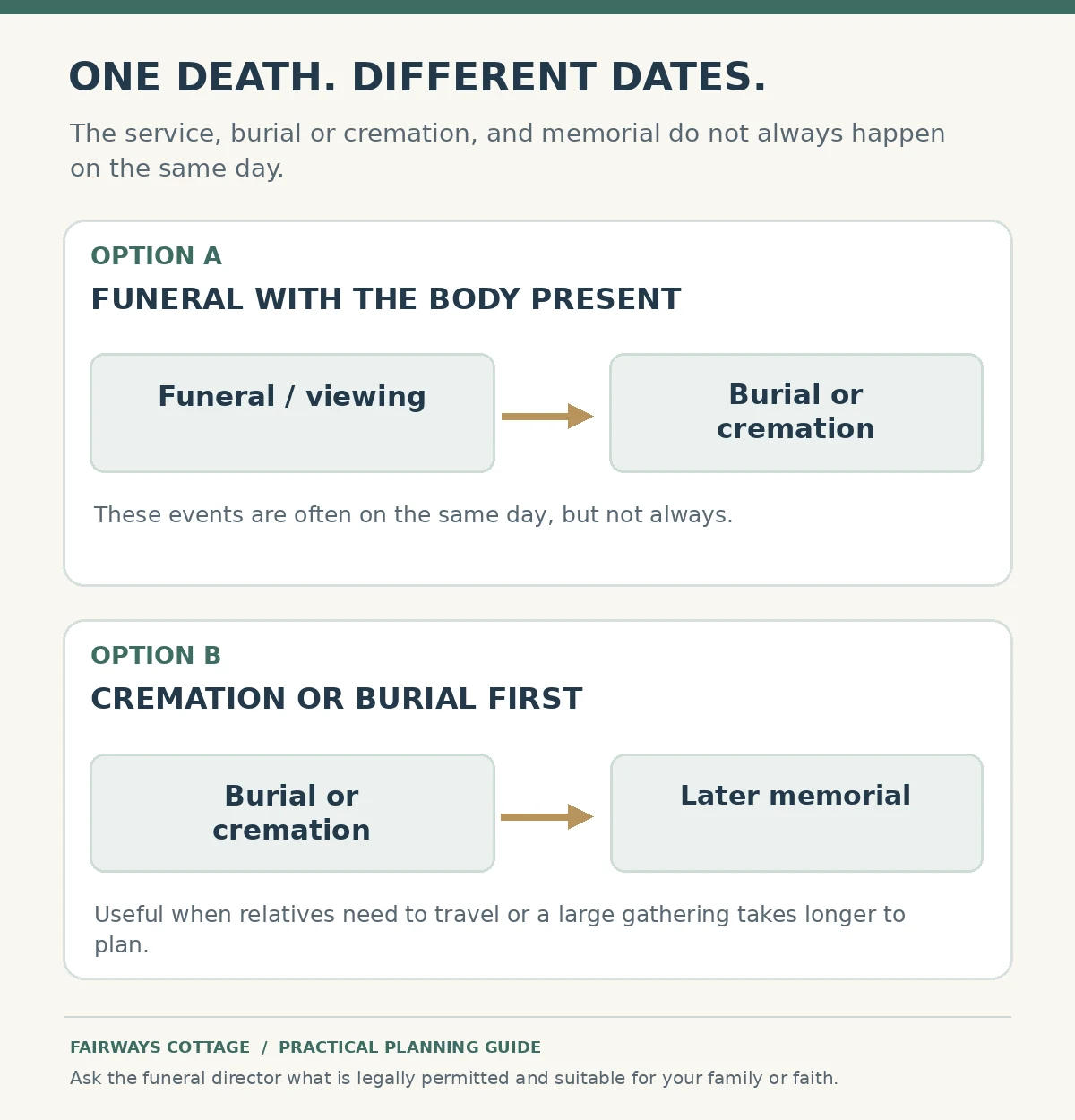
This distinction is particularly valuable if a loved one died far from home, if family members cannot travel quickly, or if a ceremony with the body present is not essential.
What Happens Between a Death and the Funeral?
There is no single sequence that every family follows, but this illustrative planning timeline shows the main steps. Some happen on the same day; others take longer. It is not a promise that a funeral will occur by day seven.
Immediately after the death: confirmation and the right contacts
If the death was expected under hospice or medical care, follow the instructions provided by that care team. If the death was unexpected or the circumstances are unclear, contact the appropriate emergency or local authority service. The process for verifying the death and deciding whether an investigation is needed varies by location.
Make sure the relevant person or agency knows about any religious need for prompt burial at the outset. It is easier to accommodate an urgent request before arrangements have moved further along.
The next steps: documents, release, and care of the body
The medical practitioner, medical examiner, coroner, registrar, or other authority may need to complete their part of the process. A funeral director can explain which documents and permissions are needed for burial or cremation in your area.
You can often start discussing services and obtaining prices while paperwork is underway. However, an official death certificate is not universally required to be in your hands before every planning step; the specific paperwork depends on the country and type of disposition. Avoid treating registration, certification, and the burial or cremation permit as interchangeable documents.
If the person will not be buried or cremated promptly, ask about appropriate professional care, including refrigeration or embalming where relevant and legally permitted.
Once release and permissions are clear: choose the date
Confirm the availability of the funeral director, place of worship or celebrant, cemetery or crematorium, and the people whose attendance matters most. Ask when a booking becomes firm and what fees could apply if the date changes.
Only then finalize travel, printed programs, catered receptions, or other costs that may be difficult to recover.
Seven Reasons a Funeral May Be Sooner or Later
1. Religious and cultural practices
Some traditions favor a prompt burial or cremation and may have requirements for washing, shrouding, prayers, or handling the body. These requirements should be raised immediately with the funeral director and the family’s religious leader.
2. A coroner, medical examiner, or post-mortem examination
An unexpected death may need to be investigated before the person can be released. This can add days or longer. In England and Wales, GOV.UK explains that a coroner releases the body once the necessary examinations are complete. An inquest does not always have to be fully finished before a funeral can be held. Ask the relevant office what is still outstanding rather than assuming every investigation takes a week.
3. Burial and cremation paperwork
The legal steps for burial and cremation are not always the same. Cremation may require additional authorization or a statutory waiting period in some US states, for example. There is no reliable national waiting-time rule to apply to every country, state, or province.
4. Funeral home, clergy, and venue availability
The funeral director may have a date available before the cemetery does—or the officiant may not be available until later. Weekends and public holidays can affect staffing, costs, or the timing of required paperwork.
5. Relatives who live far away
Waiting for someone to fly home is a common, practical reason for a later ceremony. If a delay conflicts with faith requirements or creates additional body-care costs, a smaller prompt burial or cremation followed by a memorial can be a compromise.
6. A death overseas or the need to transport the body
Repatriation and long-distance transport can involve more than one funeral provider, government permission, transportation arrangements, and documents. Ask which paperwork is needed in both locations, and whether a later memorial would avoid putting the ceremony on hold.
7. The family’s preferences, budget, and the type of gathering
A simple graveside service can require fewer arrangements than a large service with a viewing, live music, multiple venues, catering, and printed materials. Some families prefer a modest ceremony now and a larger celebration later. Ask about storage charges, extra viewing days, and weekend fees before deciding that a delay is necessary.
How Does Religion Affect Funeral Timing?
These are broad patterns, not rules for every person within a religion. Families, denominations, regions, and local laws may differ.
| Tradition | General approach to timing | Useful planning note |
|---|---|---|
| Judaism | Burial is traditionally arranged as soon as possible, often within 24 hours when feasible. | Shabbat, festivals, legal requirements, and other significant reasons can affect timing; contact the local chevra kadisha or rabbi. |
| Islam | Burial is generally encouraged as soon as practicable. | Washing, shrouding, funeral prayer, and burial are commonly coordinated with the mosque or local Muslim community. |
| Hinduism | Cremation is often preferred promptly, sometimes within a day or two. | Practices vary substantially; avoid assuming all families follow the same rites or mourning period. |
| Christianity | Many Protestant and Catholic services are arranged over several days or weeks. | Catholic rites may involve a vigil, funeral liturgy, and committal; Orthodox and other traditions have distinct customs. |
| Buddhism | Timing and ceremonies vary by Buddhist tradition and country. | Ask the family or spiritual leader about chanting, viewing, cremation, and later commemorations. |
| Secular or nonreligious | Timing is generally shaped by the family’s wishes and local requirements. | Burial or cremation can occur first, with a later memorial at a convenient date. |
The Chabad guide to Jewish funeral timing, Dar al-Ifta’s guidance on prompt Islamic burial, and the US Conference of Catholic Bishops’ overview of funeral rites provide further context.
An important question to ask: “Are there any preparations or procedures our faith would prefer us to avoid before burial or cremation?” That conversation may affect decisions about embalming, viewing, or cremation.
How Long Can You Wait Before a Funeral?
There is no single worldwide legal deadline for holding a funeral. In many places, the rules focus on registering a death, obtaining permission for burial or cremation, and caring appropriately for the body while arrangements are made. These are separate issues.
Can a funeral be held two weeks after death?
Yes, in many circumstances. A funeral held two weeks after death is not automatically unusual or inappropriate, particularly in the UK or when a delay is needed for travel or a medical investigation. Professional body care and any local requirements must be addressed.
What about three weeks, a month, or longer?
A body-present service may sometimes be delayed for weeks, depending on the circumstances and professional care available; do not assume a funeral home can accommodate any requested period. Ask the director what is feasible, what the continuing costs would be, and whether an earlier burial or cremation followed by a later memorial would be simpler.
A memorial without the body present can be held much later. That can give relatives time to travel, allow a meaningful anniversary date, or reduce the pressure to organize an elaborate event immediately.
Is embalming legally required when a funeral is delayed?
Not automatically. In the United States, the Federal Trade Commission states that no state requires routine embalming for every death. Some circumstances may call for embalming or refrigeration; rules and funeral-home policies differ. Public viewing and transport can also affect available options.
Ask the funeral director:
- Is embalming legally required for this situation, or is it your business’s viewing policy?
- Can refrigeration be used instead, and what does it cost per day?
- Will a private family viewing be possible without embalming?
- Are there religious, environmental, or personal preferences we should consider?
Do not try to manage a prolonged delay or body preservation without guidance from qualified local professionals.
How to Choose a Funeral Date Without Making a Costly Mistake
You may feel pressure to announce a date straight away. This short checklist can help you decide what is ready to confirm and what should remain tentative.
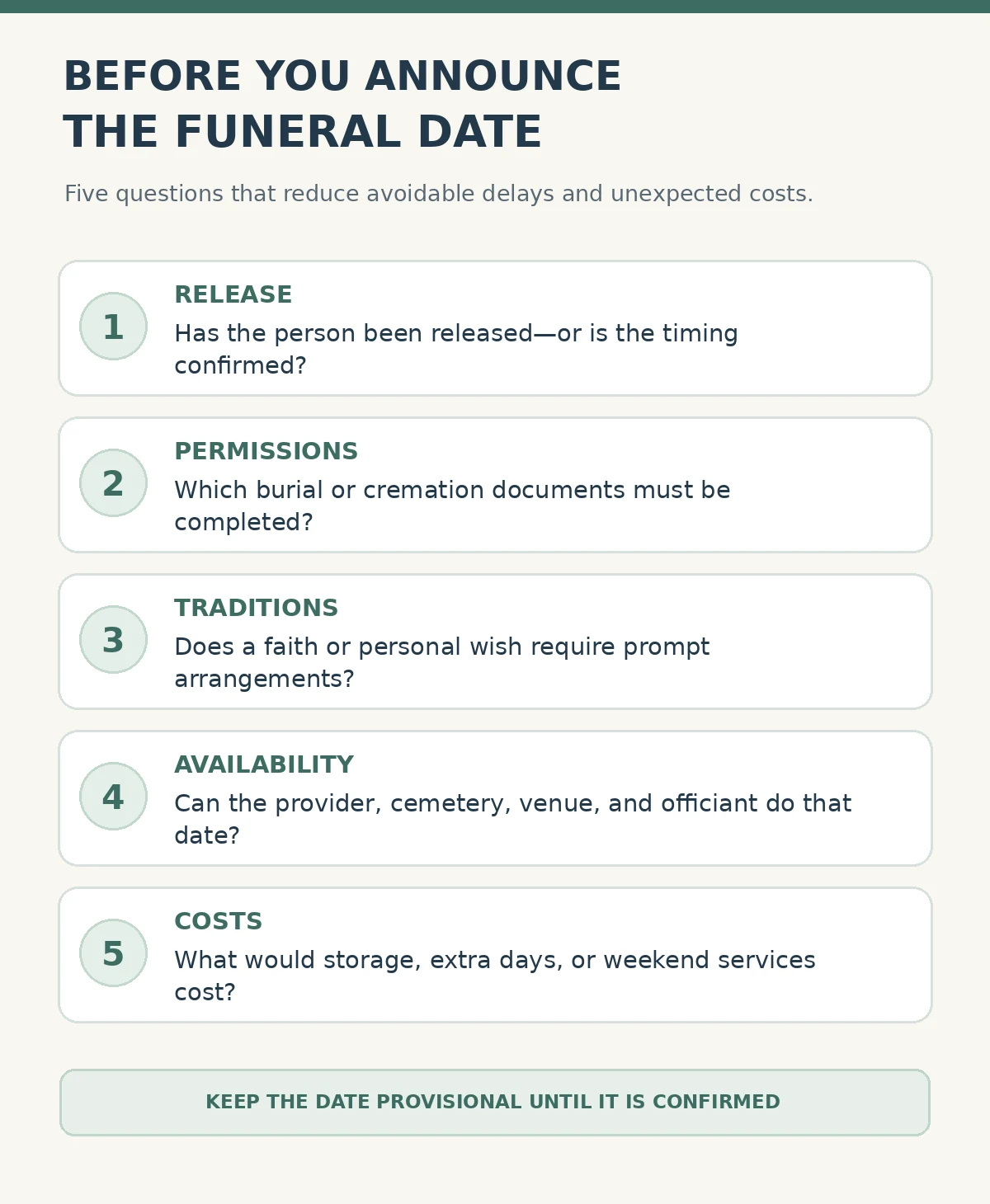
Step 1: Check what has actually been authorized
Has the person been released or is release expected on a confirmed date? Which burial or cremation permits are still needed? If an investigation is underway, ask when the responsible office expects to know more—not just when the funeral home hopes it will be finished.
Step 2: Ask whether faith or family wishes require prompt arrangements
If the tradition calls for rapid burial, speak to the religious leader and funeral director before delaying for a larger gathering. If the deceased left instructions, consider them and ask who has the legal authority to make final decisions.
Step 3: Find out which service formats are possible
Does the family want a viewing and funeral with the body present, a graveside gathering, direct cremation, or an eventual memorial? The choice can change how soon a ceremony can realistically occur.
Step 4: Confirm availability and the full cost of waiting
Ask the funeral home, cemetery or crematorium, and officiant for available dates. Request an itemized estimate and ask specifically about refrigeration, viewing, transport, and weekend or holiday charges.
Step 5: Choose the date and communicate it carefully
Before the date is fully confirmed, tell relatives it is provisional. Once the necessary permissions and venues are secure, send the date, time, location, dress expectations if any, and information for people who cannot attend. For those traveling, consider whether a livestream or later gathering would help.
Two Realistic Examples of Funeral Scheduling
Example A: An expected death with a local funeral
Someone dies on a Monday while receiving medical care. The family contacts the appropriate service and funeral director, discusses the preferred burial and service, and starts gathering required documents. If release, permissions, and bookings are completed promptly, a service toward the end of that week may be possible. If an authorization or venue is delayed, the ceremony moves to the following week.
This is an example of how coordination can work—not a guaranteed timetable for a Monday death.
Example B: A death abroad with relatives arriving later
A family member dies overseas and transport arrangements will take time. Rather than announce a funeral date before the necessary clearances are known, the family asks the funeral provider about repatriation, temporary care, and local fees. They consider a smaller burial or cremation when permitted, followed by a memorial once the wider family can gather.
A plan with two dates may be kinder and more practical than trying to make one event accommodate every constraint.
Questions to Ask the Funeral Director Today
You can save or copy these questions into your phone before calling:
- What is the earliest realistic date for a funeral in our circumstances? What still needs to happen before that date is firm?
- Has the person been released, or is an investigation still underway? Who can provide the next update?
- What documents and permits are required for burial or cremation here? Who obtains them?
- What care is appropriate while we wait? Are refrigeration or embalming necessary, optional, or part of your policy?
- What extra costs could a later date create? Please include daily care, venue fees, transportation, and weekend charges.
- Could we have a small service now and a memorial later? What choices would that involve?
- When should we announce the date? What happens financially if we need to change it?
If you are arranging a funeral in the United States, the FTC’s Funeral Rule generally gives consumers important rights to price information and to choose funeral goods and services separately. Those specific federal consumer protections do not apply outside the US.
Frequently Asked Questions
Can a funeral happen the day after someone dies?
Sometimes, particularly where prompt burial is a religious priority and release, local permits, and arrangements can be completed quickly. It is not guaranteed, and cremation may be subject to additional local waiting periods or authorization.
Is a funeral normally three days after death?
Three days is possible in some communities, but there is no universal three-day rule. A commonly cited US planning range is roughly three to seven days, while UK providers often describe one to two weeks.
Do funerals have to happen within seven days?
No universal seven-day deadline applies. The relevant laws may govern registration, disposition authorizations, or the care of the body rather than the funeral service date. Ask a local funeral director or appropriate authority about the rules where the death occurred.
Why would a funeral be delayed for two weeks or longer?
Common reasons include a coroner or medical examiner investigation, waiting for documentation, an unavailable crematorium or cemetery, religious arrangements, repatriation, relatives traveling, or a family decision to hold a later ceremony.
Can we plan a funeral before receiving the death certificate?
You can often speak with a funeral director, compare options, and make provisional arrangements before every document is finalized. However, you may need particular documents or authorizations before burial or cremation can go ahead. Ask exactly which ones apply in your jurisdiction.
How long after death can someone be cremated?
The timing depends on the required authorization, local rules, any applicable waiting period, and crematorium availability. There is no safe worldwide number of days. If you wish to hold a later memorial, that gathering need not occur on the cremation date.
Does a post-mortem mean we must wait until an inquest is over?
Not always. The responsible authority generally needs to complete any examinations necessary before release, but a full inquest can continue after the person has been released. Confirm the status with the coroner or medical examiner rather than assuming the whole inquiry must finish first.
Can a funeral be held on a weekend?
Often yes, if the funeral home, officiant, and cemetery or crematorium can accommodate it. Availability may be limited and extra charges may apply. Ask for a written estimate before choosing the day.
What if the family cannot agree on the date?
Start by identifying who has the legal authority to make arrangements, whether the deceased left clear wishes, and whether faith requirements or release deadlines constrain the options. A funeral director may help explain the choices, but legal disputes may require local legal advice. A smaller ceremony and a later memorial can sometimes reduce conflict.
The Bottom Line
Most families do not need to find one “correct” number of days. They need a date that respects the deceased person’s wishes, meets local requirements, allows appropriate care, and is realistic for the family. A funeral within days may be right; a service a week or two later may be right; and a later memorial may be the most practical choice.
If nothing else, begin with three questions: Has the person been released? What permissions are required? Which ceremony does the family actually want? The answers will give you a much more dependable timeline than any generic countdown.
If you are also caring for someone approaching the end of life, our guides to transitioning in hospice and mottled skin before death discuss signs families may notice and ways to respond with care.
Sources and Editorial Notes
This article was researched and reviewed in November 2026 using government, consumer-protection, religious, and funeral-industry guidance. The ranges above are approximate planning examples, not official statistics or legal advice. Rules vary by country and locality, and individual circumstances take precedence.
- Federal Trade Commission: The FTC Funeral Rule — United States consumer rights, pricing, and embalming guidance.
- GOV.UK: Arrange the funeral — official guidance on arrangements in the UK.
- GOV.UK: When a death is reported to a coroner — official guidance about investigations and release.
- Dignity: How long after death does a funeral take place? — UK scheduling considerations.
- Co-op Funeralcare: How long after death is a funeral? — typical UK timing.
- Chabad: Timing of the Jewish Funeral Service — traditional Jewish timing and exceptions.
- Dar al-Ifta: The funeral prayer and prompt burial — Islamic guidance.
- USCCB: Overview of Catholic funeral rites — Catholic rite structure.