
How Long Can a Hospice Patient Live Without Water?

When a hospice patient stops drinking completely, death may follow within a few days; some people live around a week or longer. A hospice provider describes a broad range of a few days to a week, but that is not a countdown and it does not predict what will happen to one particular person. The underlying illness, remaining fluid intake and overall pattern of decline matter more than the number of hours since the last sip. VITAS Healthcare explains this variability.
A sudden refusal or inability to drink should not automatically be dismissed as “just dying.” Even with hospice care, it can be important to check for treatable causes such as mouth pain, infection, medication effects or swallowing problems. Tell the hospice nurse about a new change in drinking, particularly if the person is distressed.
What to do right now: Offer a small sip only if the person wants it, is awake enough and can swallow safely. Do not force drinks or put water into an unresponsive person’s mouth. If swallowing is unsafe, ask the hospice team to show you gentle mouth care. For sudden changes or distress, contact the team promptly.
About this guide: This article explains common end-of-life changes, not a diagnosis or an instruction to withhold fluids. The person’s choices, clinical condition and individualized care plan come first. Hospice practices and emergency contact arrangements vary by provider and country.
How long can someone on hospice live without water?
For a person already in the final phase of a life-limiting illness, completely stopping fluids often means days rather than weeks. VITAS gives a general estimate of a few days to one week, while other hospice sources emphasize that no single duration applies to everyone. A person may die sooner because the illness is already progressing, or may live longer despite taking very little by mouth. St. Croix Hospice stresses the limits of prediction.
This estimate refers to someone thought to be approaching death—not a healthy adult deprived of water, and not every person enrolled in hospice. Hospice eligibility can begin months before the final days. Do not assume that someone who is still talking, walking or recovering from another illness has only days left simply because they refused drinks today.
What changes the timeline?
- Where they are in the illness: A person who is already barely responsive may be closer to death than someone who remains alert and active.
- Whether “no water” means none at all: Ice chips, thickened fluids, soups, tube feeding and IV or under-the-skin fluids mean intake is not truly zero.
- Health and fluid balance: Kidney or heart problems, fever, vomiting, diarrhea and medicines can influence hydration and symptoms.
- The reason drinking stopped: A short-term illness, painful mouth or medication effect may be partly reversible; declining intake as the body shuts down is a different situation.
Rather than trying to calculate an exact day, ask the nurse, “Do the changes you see suggest my loved one is in the last days, and what findings are you basing that on?” A clinician can assess several signs together and explain the remaining uncertainty. For the broader clinical context, see common signs death is approaching.
Why do hospice patients stop drinking?
Near the end of life, thirst and appetite commonly decrease as metabolism, awareness and swallowing change. A person may sleep much of the day, struggle to coordinate a swallow, or simply no longer want drinks. Marie Curie describes these changes as common in the last weeks, days and hours, while reminding families that reduced intake can have other causes.
Not every reduction in drinking is caused by the dying process. Before assuming it is expected, the hospice team may check for problems that can be addressed in a way consistent with the person’s goals.
| Possible explanation | What families might notice | Helpful next step |
|---|---|---|
| Expected decline near death | Increasing sleep, little interest in drinks, weakness alongside other end-of-life changes | Ask for an assessment and a comfort-focused mouth-care plan |
| Mouth or throat discomfort | Sores, white patches, dry painful mouth, grimacing when offered liquids | Tell the nurse; ask about oral care and treatment |
| Swallowing difficulty | Coughing, choking, wet or gurgly voice after sips, fluid held in the mouth | Stop offering drinks until the team advises a safer approach |
| Potentially reversible illness or medication effect | New confusion, fever, vomiting or a sudden drop in intake | Call the hospice team promptly for assessment |
These are examples, not a home diagnostic test. They also explain why the original idea that stopping water is never a medical concern is unsafe.
Does stopping drinking mean the person is suffering?
Not necessarily. A person in the final days of life may not experience thirst in the way a healthy person would when dehydrated. However, it would be misleading to promise that no one experiences discomfort. A dry, sticky or sore mouth can be distressing, and pain, agitation, fever or nausea still deserve treatment.
Dry lips do not, by themselves, prove that someone needs an IV drip. Mouth-breathing, medicines, oxygen and reduced saliva can also make the mouth dry. Gentle oral care, comfortable positioning and symptom treatment may relieve distress more effectively than automatically giving extra fluid. NHS patient guidance explains this distinction.
A more useful question than “Are they dehydrated?” is: “What is making them uncomfortable right now, and which treatment is most likely to help?”
Should you keep offering water? A simple safety guide
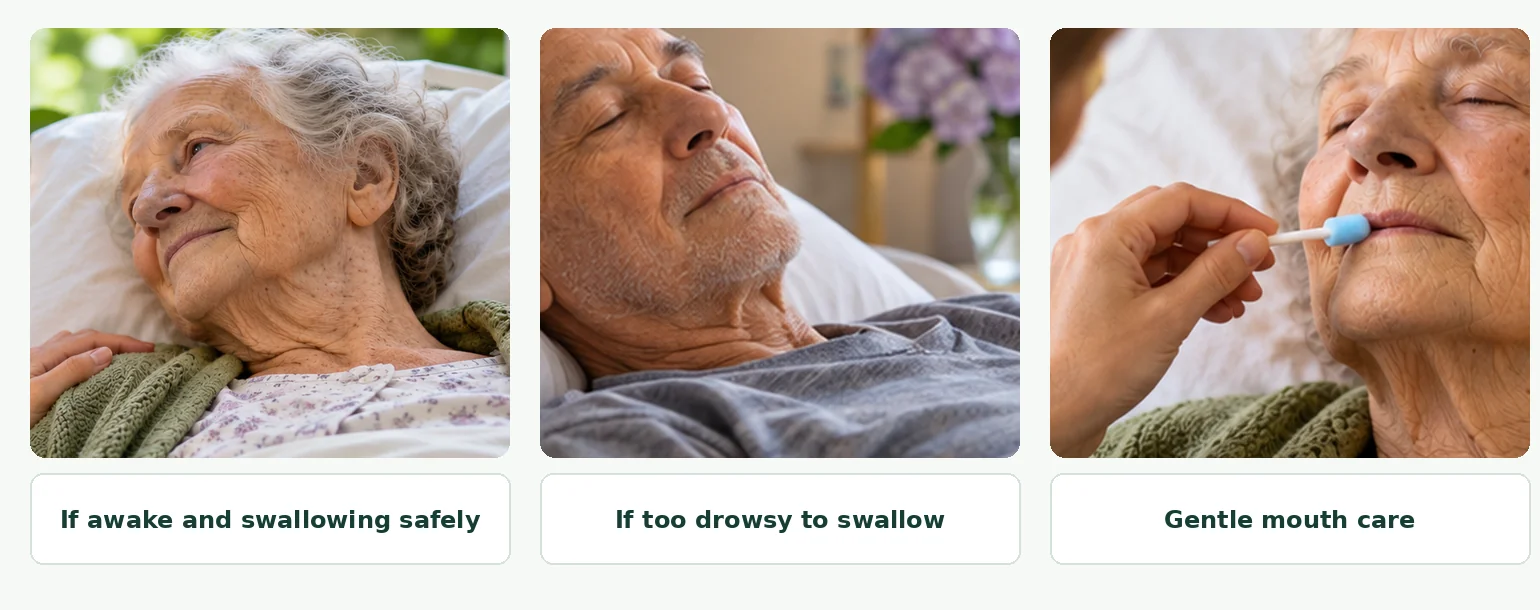
Respect the person’s wishes while protecting their airway. If they are alert, interested in drinking and able to swallow safely, their clinical team may recommend small sips or tiny amounts of a preferred drink while they are supported upright. If they turn away, close their mouth or decline, do not pressure them.
When to stop offering fluids by mouth
- They cough, choke, struggle to catch their breath or sound wet or gurgly after a sip.
- They are too sleepy to coordinate swallowing, or liquid stays in their mouth.
- They show signs of distress, pull away or clearly do not want a drink.
- The care team has advised against oral fluids because of aspiration risk.
If any of these occur, do not try to solve the problem by using a straw, syringe, teaspoon or repeated prompting on your own. Contact the nurse for individualized advice. Food or liquids entering the airway can cause choking and aspiration-related complications. The National Cancer Institute advises against forcing fluids in the final days of life.
How to keep the mouth comfortable when drinking stops
Mouth care is one of the most useful things a family member can do when someone is no longer swallowing much. It is care, not a substitute for a clinical evaluation of distress or a decision about hydration. Ask a hospice nurse to demonstrate the technique and suggest products suitable for the person’s mouth and airway.
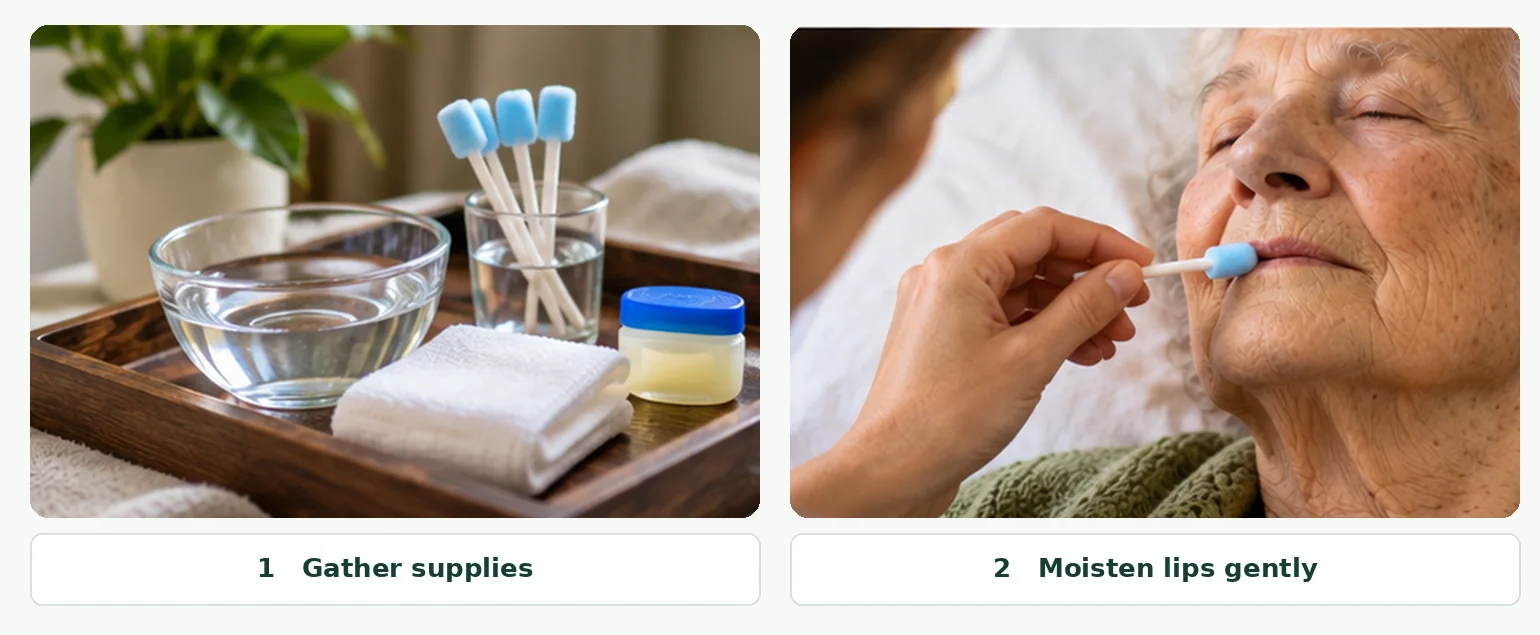
- Wash your hands and prepare supplies. Your nurse may recommend a very soft toothbrush, damp cloth, oral moisturizer or suitable mouth-care swab.
- Help the person into a comfortable position. Follow the nurse’s instructions, especially if they are drowsy, have difficulty swallowing or have a feeding tube.
- Gently clean and moisten the mouth. Use only a small amount of moisture and avoid letting fluid collect in the mouth. Never pour water into the mouth of an unresponsive person.
- Care for the lips. Apply a suitable lip moisturizer. Ask the care team what is safe, particularly if supplemental oxygen is in use.
- Watch for discomfort. Report cracked or bleeding areas, oral sores, white patches, grimacing or persistent dryness despite care.
Do not place loose ice chips or food in the mouth of someone who is barely conscious or cannot swallow safely. If the person is alert and enjoys ice chips, ask the team whether they are appropriate. Avoid petroleum-based lip products near oxygen equipment unless the care team explicitly confirms safety; oxygen increases fire risk. Marie Curie provides additional family guidance.
Would IV fluids or a drip help?
Sometimes families ask whether a person who has stopped drinking should receive intravenous (IV) or subcutaneous (under-the-skin) fluids. There is no single answer for every hospice patient. The decision depends on the person’s goals, symptoms, expected benefits, risks and the clinical situation. Hospice does not automatically mean that every kind of assisted hydration is prohibited. Our separate guide to eating less in hospice covers food and nutrition decisions.
For adults thought to be in the last days of life, evidence has not established that clinically assisted hydration routinely prolongs survival or improves quality of life. Fluids can sometimes be considered for particular symptoms or potentially reversible dehydration, but may also cause swelling, increased respiratory secretions or discomfort from the line itself. NICE recommends individualized discussion and reassessment; the NCI also recommends discussing goals of care.
| Option | Possible benefit | Important limitation or risk |
|---|---|---|
| Small amounts by mouth, if safe | Respects preference; can ease thirst and provide enjoyment | Unsafe swallowing may lead to choking or aspiration |
| Frequent mouth and lip care | Can relieve local dryness without requiring swallowing | Does not treat every cause of discomfort or reversible illness |
| Clinically assisted hydration | May be useful for a particular symptom or treatable problem | Not routinely proven to improve survival or comfort in the final days; may worsen fluid overload or secretions |
Five questions before agreeing to or declining assisted hydration
- What are we hoping the fluids will improve: thirst, confusion, comfort, or something else?
- Is my loved one thought to be actively dying, or could something reversible explain the change?
- What benefits and harms are realistic given their heart, kidney and breathing problems?
- Could we try a time-limited plan, and which signs would make us stop or change it?
- How do their stated wishes, advance directive and goals of care guide the decision?
The final decision should be made with the patient wherever possible, or through the appropriate decision-maker and clinical team. Do not stop or start prescribed fluids or alter medication routes without professional guidance.
Other changes that may appear as death approaches
Drinking less is only one clue. When death is near, several changes may appear together. Their timing varies, and no single symptom predicts an exact number of hours or days.
- Greater sleepiness: The person may sleep for long periods or become less responsive.
- Less urine: The amount may become small and darker; this can also be influenced by other health issues.
- Breathing changes: Breathing may become irregular, with pauses or new noisy secretions.
- Skin and circulation changes: Hands or feet may cool, and the skin may show mottling or other color changes.
- Restlessness or confusion: These may occur near death but can also have treatable causes; tell the hospice team.
- Less interest in food and medication by mouth: The clinician may need to review how symptom-control medicines are given.
For more detail, see our guides to transitioning in hospice and mottled skin before death. The NHS also describes common last-days changes.
When should you call the hospice nurse?
Even if drinking less is expected, tell the hospice team about a new or substantial change. You do not need to wait until the person becomes distressed. Your care team can confirm what is expected, look for treatable discomfort and review the plan.
Contact the hospice team promptly if you notice:
- A sudden change in alertness, confusion, ability to drink or behavior, especially if the person was doing better recently.
- Coughing, choking, wet-sounding breathing or trouble swallowing when fluids are offered.
- Painful mouth sores, persistent thirst or dryness that mouth care does not relieve.
- New agitation, grimacing, anxiety, fever, vomiting or other signs of distress.
- Uncontrolled pain, breathlessness or symptoms not responding to the current care plan.
- Uncertainty about how to give prescribed medications when swallowing is difficult.
What about an emergency?
If the person has severe breathing difficulty, uncontrolled bleeding or another rapidly developing crisis, use the urgent-response plan provided by their hospice team and call the on-call number immediately. If you cannot reach the team and there is an immediate threat to safety, seek emergency assistance according to the person’s wishes, local emergency arrangements and documented care plan. Do not assume all sudden symptoms are harmless simply because someone has a hospice diagnosis.
Useful phone script: “My loved one receives hospice care for (name the condition). They last had a meaningful drink at (give the approximate time). They are now (describe whether they are alert, drowsy, or unresponsive), and I have noticed (describe any symptoms). Can a nurse assess whether this is an expected change or something we should treat, and show us how to keep their mouth comfortable?”
How to support the person and the family without forcing fluids
Comfort can be practical and personal. Keep their preferred music or a calm voice nearby if they like it. Help with positioning only as your care team advises. Offer reassurance, respect when they want rest, and arrange relief for the person providing day-to-day care. Ask who is available after hours, which medications to have on hand and who should be called when death occurs.
Families can also disagree about food and fluids. It helps to shift the conversation from “Are we giving enough water?” to “What does the person want, what is safe, and what will improve comfort?” A short discussion with the hospice nurse may make those goals clearer without placing guilt on any family member.
Frequently asked questions
Can a hospice patient survive more than a week without drinking?
Yes, it is possible, although the total time varies widely. Some people continue to receive small amounts of fluid from ice chips, foods, tube feeds or other sources without those amounts being obvious to family members. Ask the team for a prognosis based on the entire clinical picture rather than relying on a fixed number of days.
Does stopping water mean death will occur within 24 or 48 hours?
No. Reduced drinking may accompany the last days of life, but it cannot reliably pinpoint a 24- or 48-hour window. Breathing pattern, consciousness, circulation, underlying illness and clinical assessment all matter.
Should I wake a sleeping hospice patient to drink?
Do not put fluid into a sleeping or unresponsive person’s mouth. Ask the hospice team whether waking them for oral intake is appropriate, and follow the individual plan. A person who is awake, wants water and can swallow safely may still enjoy small sips.
Is a dry mouth proof that someone is thirsty or dehydrated?
No. Dry mouth can result from mouth-breathing, reduced saliva and medicines as well as dehydration. It should be treated as a possible source of discomfort and discussed with the care team. Mouth care and oral moisturizers often help.
Is giving IV fluids against the rules of hospice?
Not automatically. Whether assisted hydration is offered depends on goals of care, local practice, the expected benefit and the burden of treatment. Ask the hospice clinician to explain the options for this specific patient.
What if my loved one asks for water?
Take the request seriously. If they are awake and swallowing safely, follow the plan for small amounts by mouth. If they cannot swallow or they cough, do not force a drink; tell the nurse and request effective mouth care and symptom relief.
What is the difference between naturally stopping drinking and choosing to stop food and water?
A person naturally losing interest in fluids as an advanced illness progresses is not the same as an alert person making a deliberate decision to stop eating and drinking. They have different ethical, clinical and legal considerations. In either situation, the person’s choices and symptom management require respectful professional discussion.
What if my loved one has dementia and cannot tell us what they want?
Ask the team to assess swallowing safety and comfort, review any known wishes or advance directives, and involve the legally authorized decision-maker when needed. Marie Curie’s dementia guidance explains why swallowing and intake can change in advanced dementia.
Key takeaways
- When someone is already dying, stopping fluids completely is often followed by death within days; it is not a reliable countdown.
- Do not force drinks or give liquids to a person who cannot swallow safely.
- Dry mouth and other signs of discomfort deserve attention; gentle mouth care can be valuable.
- IV or subcutaneous fluids may help in selected circumstances but are not routinely proven to prolong life or improve comfort in the final days.
- Contact the hospice team about sudden changes, uncertainty or distress so reversible problems are not overlooked.
The aim is not to ignore hydration or turn a difficult moment into a timetable. It is to understand what is happening, respect the person’s wishes and make sure they receive attentive comfort care.
Sources and further reading
This article was developed from published clinical guidance and hospice education resources. The sources below support the general discussion; they do not replace an individualized medical assessment.
- NICE — Care of dying adults in the last days of life (NG31), maintaining hydration.
- National Cancer Institute — Last Days of Life (patient guide).
- Marie Curie — Eating and drinking less at the end of life.
- NHS — Changes in the last hours and days.
- VITAS Healthcare — When a hospice patient stops eating or drinking.
- St. Croix Hospice — When your loved one stops eating or drinking.