

5 Stages of Palliative Care

When someone says there are five stages of palliative care, it can sound as though every person with a serious illness follows the same predictable path. That is not how palliative care works. Some care providers describe five steps in a support process; meanwhile, a recognized clinical system describes four phases of patient care—stable, unstable, deteriorating and terminal—plus bereavement support after death. People may move between phases, and receiving palliative care does not mean death is close.
The short answer: The five commonly described phases are stable, unstable, deteriorating, terminal and bereavement. They describe changing needs, not a countdown. Palliative care can begin early, alongside treatment intended to manage or cure a disease. What matters most is the person’s symptoms, goals and preferences—not which box they supposedly belong in.
If you are trying to understand what happens next for a parent, partner, friend or yourself, this guide explains the different frameworks, what each phase may mean, which questions help most, and when to call the care team.
Important: This is general education, not a prognosis or a replacement for advice from the treating team. New severe symptoms warrant prompt clinical assessment. If a person has a documented hospice or comfort-focused emergency plan, follow that plan and contact the care team.
What are the 5 stages of palliative care?
There is no single universal sequence called the “five stages of palliative care.” Two different meanings appear in online articles:
- Clinical phases: The Palliative Care Outcomes Collaboration (PCOC), an Australian program, assesses four patient phases—stable, unstable, deteriorating and terminal—and also documents bereavement support following death. The phases are based on current needs and may change in either direction.
- Care-delivery steps: Other organizations organize palliative care into planning, emotional support, symptom management, end-of-life care and bereavement. These describe components of support rather than discrete biological stages, and many happen at the same time.
The Australian Institute of Health and Welfare’s palliative care glossary and PCOC’s phase guidance provide the clinical context. The World Health Organization explains why palliative care should not be restricted to the final days of life.
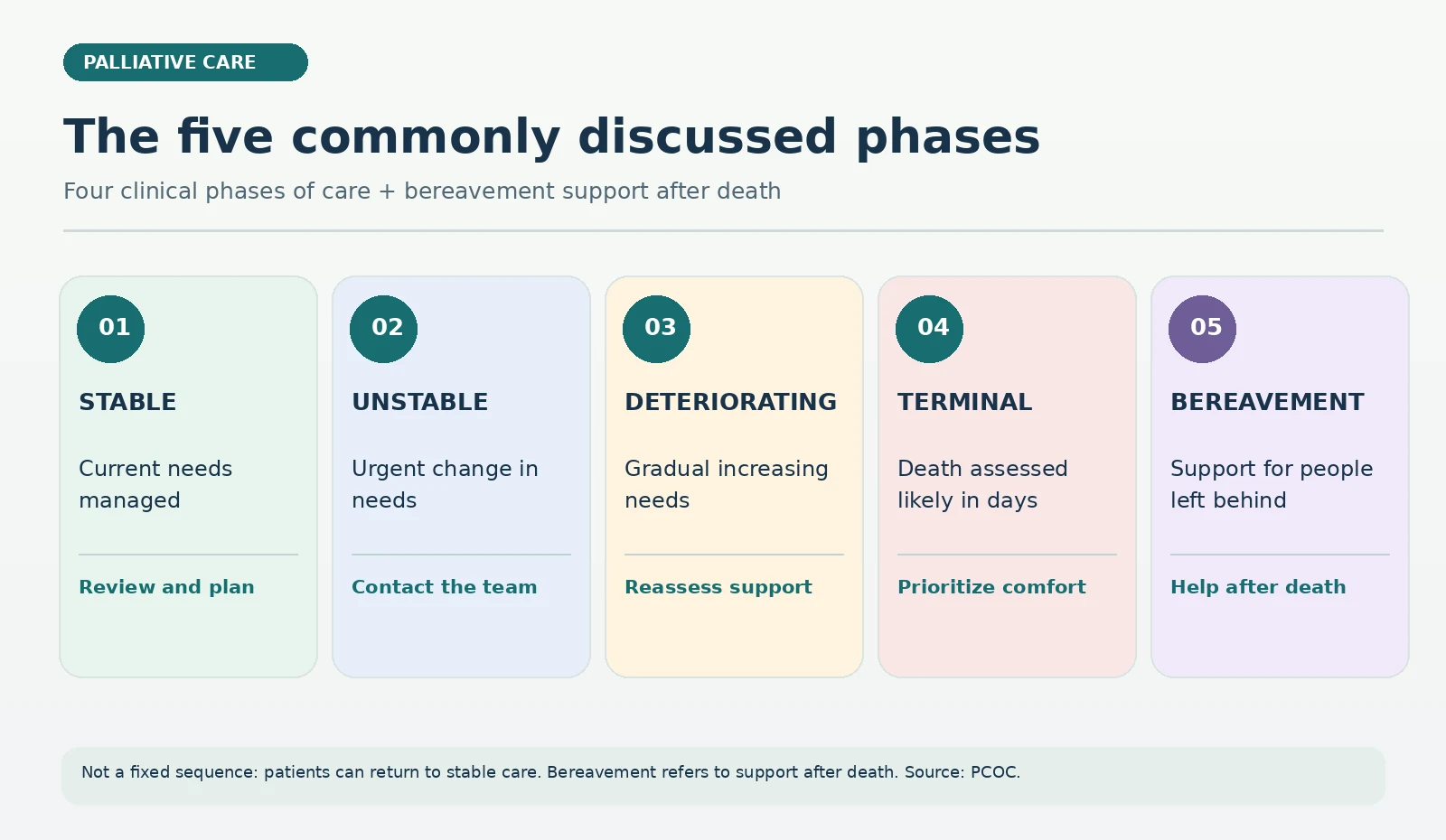
The phases at a glance
| Phase | What it means | Helpful family question |
|---|---|---|
| Stable | Existing symptoms and problems are sufficiently addressed by a plan; regular review continues. | “Who do we call if something changes?” |
| Unstable | A new problem or sudden change requires an urgent adjustment to the care plan. | “What needs action today?” |
| Deteriorating | Health, function or caregiver needs are gradually worsening, and the plan requires review. | “What extra support will we need next?” |
| Terminal | The team assesses that death is likely within days; comfort and individualized support are priorities. | “How will you keep them comfortable, and whom should we call?” |
| Bereavement | After death, support focuses on relatives and other people important to the person. | “What grief support is available to us?” |
These are not five steps everyone must complete. A person can move from an unstable phase back to stable. Someone may deteriorate gradually without a separate unstable phase. The bereavement phase concerns support to others after the patient has died, not a fifth phase experienced by the patient.
Phase 1: Stable — when the care plan is working
“Stable” does not mean the illness has disappeared. It means that the person’s current concerns—for example, pain, breathlessness, nausea, anxiety or family support—are being managed by an established care plan, with follow-up as needed. A person can be living with advanced disease and still be in the stable phase.
What care may involve: reviewing symptoms and medications; discussing goals; arranging mobility or daily-living support; helping with sleep and nutrition concerns; identifying whom to contact out of hours; and making sure family caregivers understand the plan. Some people are also receiving chemotherapy, dialysis, heart-failure treatment or other disease-directed care.
Practical actions for family: Keep a simple symptom record: what changed, when, what helped and what did not. Ask for an updated medication list, including the reason for each prescription. Find out whether your team has an after-hours phone number. Check whether you have the equipment and help needed to manage safely at home.
Ask the team: “What would tell us that the plan is no longer working, and what should we do first?”
Phase 2: Unstable — when something changes suddenly
An unstable phase means an urgent change in the plan is needed because of new or rapidly worsening symptoms, a crisis, or a sudden change in the family or caregiving situation. It does not automatically mean the person is dying.
Examples include pain that is no longer controlled, new distressing breathlessness, severe nausea, agitation, or a caregiver becoming suddenly unable to provide essential support. The right response depends on the person’s condition, treatment goals and established emergency plan.
What care may involve: same-day review by the palliative-care service, changes to prescribed medication, investigation of potentially reversible problems, urgent home support, or hospital assessment when consistent with the person’s wishes and clinical needs.
Practical actions for family: Do not independently increase doses or borrow medication. Tell the team exactly what changed and how quickly. Be ready to describe symptoms, current medicines, allergies and the person’s documented care preferences. If there are signs of an immediate medical emergency and no different emergency plan applies, seek emergency assistance.
Ask the team: “Is this a symptom crisis we can manage safely at home, or does it need urgent in-person assessment?”
Phase 3: Deteriorating — when needs increase over time
A deteriorating phase describes a more gradual decline in the person’s condition or ability to manage everyday activities, or a gradual increase in caregiver stress that affects the care plan. The change may be expected in the course of illness, but it still deserves review. It is not a precise prediction of how much time remains.
The person might need more help with bathing, walking, changing positions, taking medicine or preparing meals. They may spend more time resting. Some people develop increasing pain, fatigue or breathlessness; others experience mostly functional changes. The pattern varies widely by illness.
What care may involve: reassessing symptom control; introducing mobility aids, a hospital bed or pressure-relieving equipment when appropriate; arranging additional nursing or home-care visits; discussing swallowing safety with clinicians when needed; and preparing a plan for future changes.
Practical actions for family: Ask for a home-safety assessment. Consider who can help at night and whether respite support is available. Discuss which treatments the person wants or does not want if health worsens. Do not assume reduced intake or sleeping more necessarily means death is imminent; tell the team what you observe.
Ask the team: “Which changes are expected, which could be treated, and what would make you want us to call sooner?”
Phase 4: Terminal — when death may be within days
In the PCOC phase tool, terminal means the clinical team considers death likely within days. This is a clinical judgment, not a stopwatch; prognostic uncertainty remains. A person may become less responsive, sleep much more, take very little food or fluid, have altered breathing or develop cooler hands and feet. Not everyone develops these changes, and the presence of one sign alone cannot predict the time of death. For a closer look at appetite changes, see our guide to eating less in hospice.
The focus is on comfort and on the person’s previously expressed wishes. This can include addressing pain, breathlessness, agitation, mouth dryness and positioning needs; supporting family presence; and explaining which changes may occur. The care team should guide any medication, mouth care and swallowing decisions. Do not force food, drinks or tablets when someone cannot safely swallow. Our guide to drinking less in hospice explains hydration and comfort questions to discuss with the team.
Practical actions for family: Ask the nurse for a clear explanation of the current assessment and the plan for distressing symptoms. Keep the care team’s number close. Offer calm company in the way the person previously preferred—conversation, music, silence or simply being present. If you are uncertain whether they are comfortable, ask.
For more detail, read our guides to transitioning in hospice, signs death is approaching and mottled skin before death.
Ask the team: “What symptoms should we expect, how will discomfort be treated, and what do we do if death occurs at home?”
Phase 5: Bereavement — support after a death
Bereavement support starts from the understanding that serious illness affects family, friends and caregivers, too. After a death, people may need practical information about whom to notify, as well as emotional, cultural, spiritual or professional support.
The support available varies by local service, insurance arrangements and country. It may include follow-up calls, grief groups, counseling referrals, faith-community support, practical guidance and signposting to community resources. Not everyone needs formal grief counseling, and there is no required schedule for grief.
Practical actions for family: Ask the service what it offers and for how long. Share the practical workload with trusted people. If grief is seriously affecting safety or day-to-day functioning, contact an appropriate healthcare or mental-health professional for assessment.
For planning after a death, our funeral timing guide explains common scheduling considerations without treating any one timeline as a legal rule.
Ask the team: “Who can we call after the death, and what support is available to family members?”
A second framework: five parts of good palliative care
If you’ve seen an article listing “assessment, symptom management, emotional support, end-of-life care and bereavement” instead, that is a service roadmap, not the same as the clinical phase definitions above. It can still be helpful if presented correctly.
| Care component | When it might be needed |
|---|---|
| Assessment and shared planning | At the first referral and whenever goals or needs change |
| Pain and symptom management | Throughout serious illness, not just at the end |
| Emotional, social and spiritual support | Whenever the person or family wants or needs it |
| End-of-life comfort planning | When goals shift or when death is approaching |
| Bereavement support | Before death through anticipatory support and after death for those affected |
The vital distinction is that care components often overlap. People do not need to “graduate” from one stage to another to receive emotional support or help with symptoms.
Palliative care vs hospice care vs end-of-life care
| Type of care | Main purpose | Can someone receive disease-directed treatment? |
|---|---|---|
| Palliative care | Relieve suffering and support quality of life during serious illness | Yes. Often alongside disease-directed treatment. |
| Hospice | Coordinated comfort-focused care when a person meets the local program’s eligibility criteria and goals | Rules vary by country and program. U.S. Medicare hospice has particular election and coverage rules for the terminal condition. |
| End-of-life care | Care and decisions when a person is approaching death | Depends on the clinical situation and the person’s goals. |
The terms are related but not interchangeable. Eligibility and service models vary by location. Our article on hospice vs comfort care explains another commonly misunderstood distinction. The WHO is explicit that palliative care can be integrated early with treatment for serious illnesses.
What to ask at the next palliative-care appointment
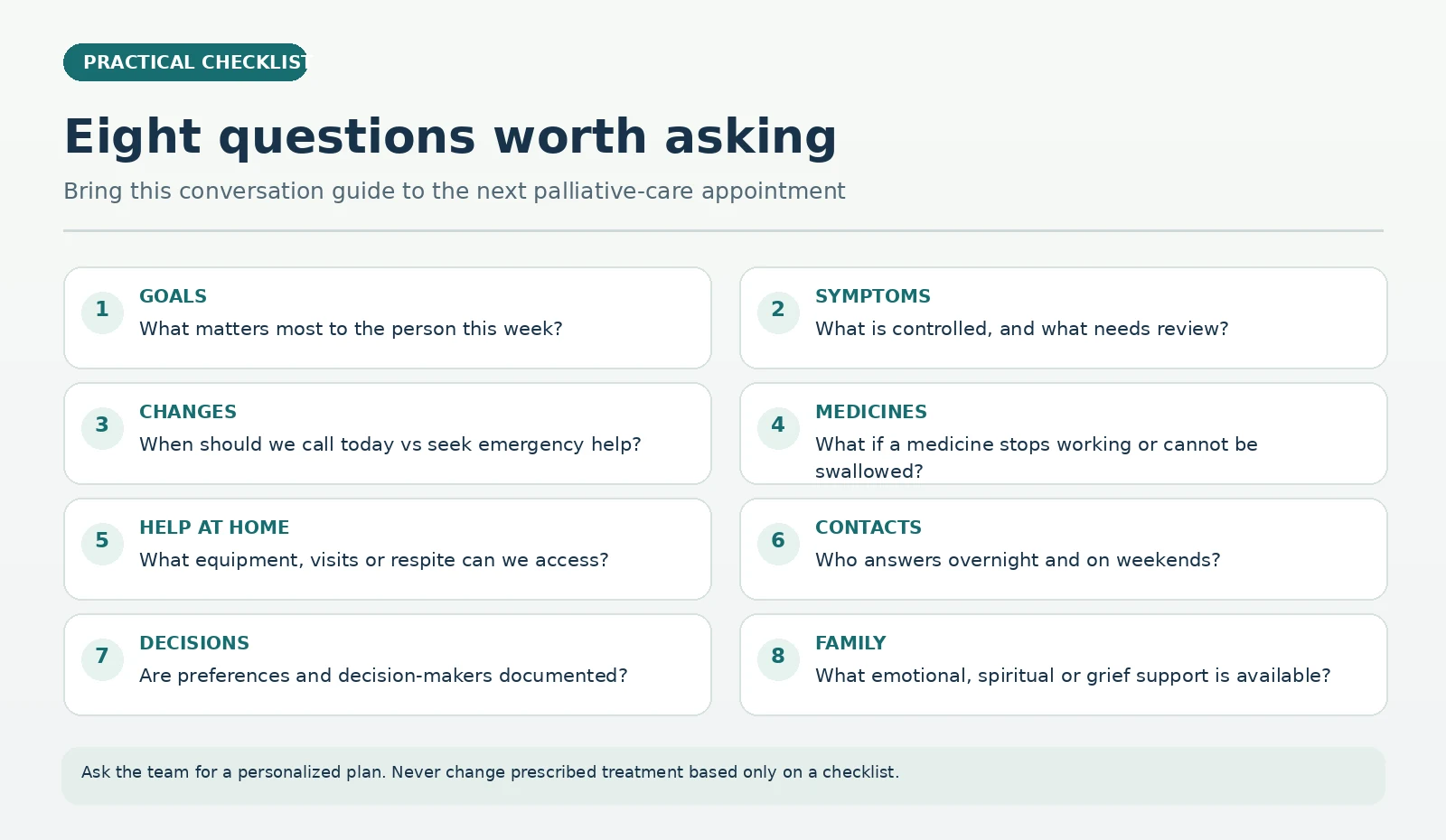
The most useful questions are often about what happens next, rather than “Which phase are we in?” Copy these to a phone note or print them:
- Goals: “What matters most to the patient, and how is the plan reflecting that?”
- Symptoms: “Which symptoms are controlled, and which need a new approach?”
- Changes: “What changes should trigger a same-day call, and what is an emergency?”
- Medicines: “Who should we call if medicines cannot be swallowed or stop working?”
- Daily care: “What equipment, nursing visits or help with bathing, moving and toileting would make care safer?”
- Communication: “Who is our main contact during office hours, overnight and on weekends?”
- Decisions: “Are the person’s preferences, advance directives and authorized decision-makers documented?”
- Caregiver support: “What respite, social work or bereavement services can our family access?”
A simple one-page care plan to make with the team
| Write down | Our answer |
|---|---|
| The person’s top priority this week | __________________ |
| Current symptoms causing most distress | __________________ |
| Medicines and instructions we have confirmed | __________________ |
| What change means “call today” | __________________ |
| What change means “seek emergency help” | __________________ |
| Daytime and out-of-hours contact numbers | __________________ |
| Who can help if the usual caregiver is unavailable | __________________ |
Keep this beside the care plan, not instead of it. Any changes to medicines, feeding, oxygen or other treatment must come from the treating professionals.
When should you call the palliative-care team?
The right urgency depends on the person’s condition and their agreed care plan. Use the following as a conversation guide, not a substitute for personalized clinical instructions.
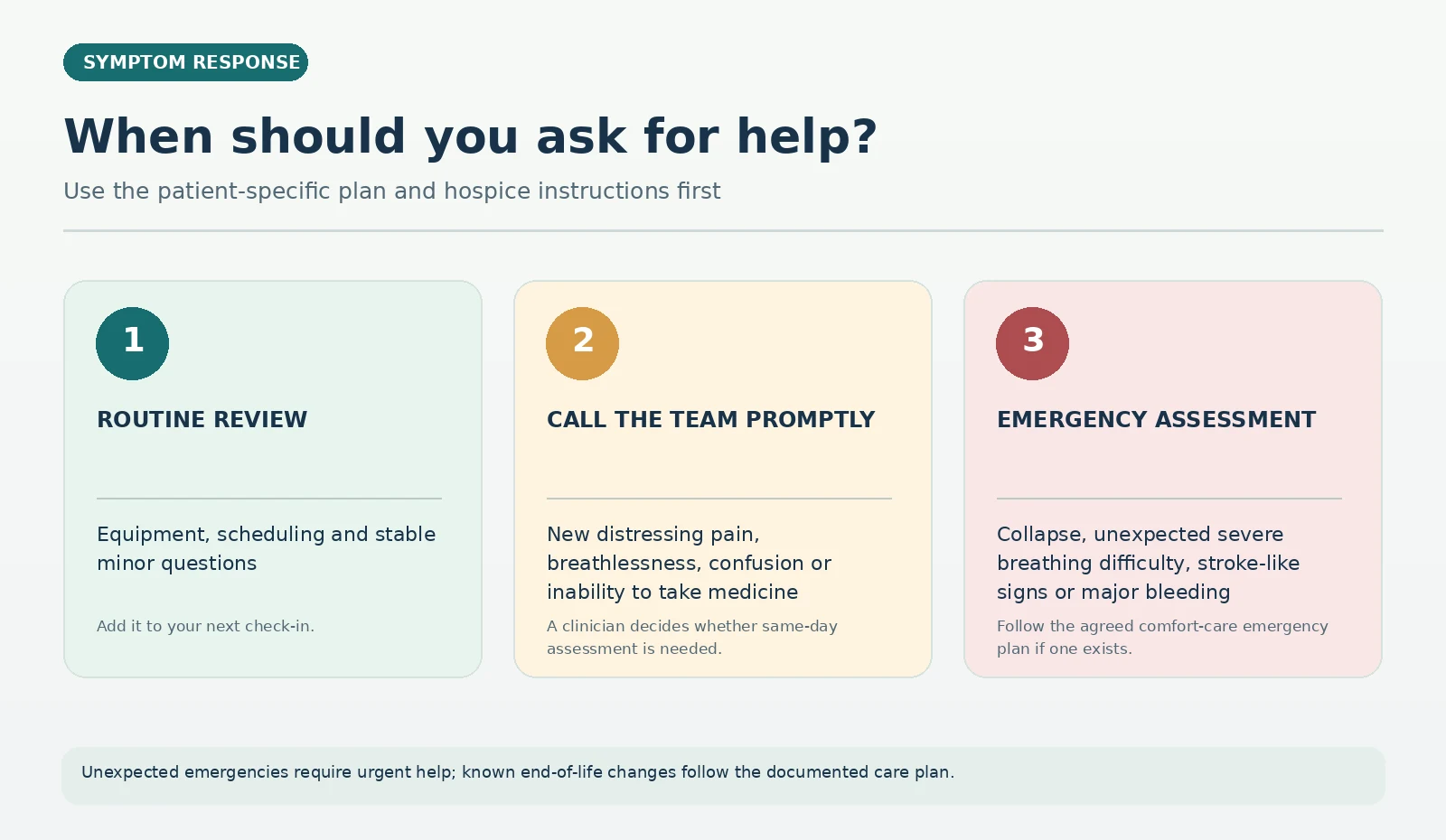
- At the next routine review: questions about equipment, scheduling, long-term planning or symptoms that remain mild and stable.
- Call the treating team promptly: newly troublesome pain, rapid functional decline, distressing breathlessness, new confusion, repeated vomiting, worsening pressure areas or inability to take essential prescribed medication. The team may instruct you to seek emergency assessment.
- Seek immediate emergency help where appropriate: collapse, severe unexpected breathing difficulty, major bleeding, a new stroke-like symptom or other acute life-threatening changes, unless a different response is clearly specified in an agreed, comfort-focused emergency plan. For someone receiving hospice, call the hospice number and follow that plan.
The goal is neither to overreact to every expected change nor to dismiss a treatable emergency as “just another stage.”
Frequently asked questions
Are the five stages of palliative care always in order?
No. Clinical phases are not sequential. Someone in an unstable phase can become stable after treatment or a change in the plan. The bereavement phase is support for others after a death.
How long does each stage last?
There is no universal duration. Some people benefit from palliative care for months or years. An unstable phase may be short if a crisis is resolved; deterioration may be gradual. The term “terminal” in the PCOC system generally describes a clinical assessment that death is likely within days, not a guarantee.
Is palliative care only for cancer or elderly patients?
No. It can help adults and children with serious illnesses such as heart, lung, kidney or neurological conditions, as well as cancer. Need is driven by suffering and support requirements, not by age alone. See the WHO’s overview.
Does entering palliative care mean treatment has stopped?
No. Palliative care can complement treatment intended to prolong life or treat a disease. Specific goals can change over time through shared decisions.
Can a patient leave palliative care?
A person’s level of service or care team may change as needs and choices change. A clinical phase is not an admission contract. Ask the provider about local eligibility and transfer arrangements.
Who decides what phase a person is in?
Where a service uses clinical phase assessment, trained clinicians assess symptoms, functional ability and patient/carer concerns. Family observations can be essential, but no online checklist can assign a reliable phase or prognosis independently.
The takeaway
The phrase “five stages of palliative care” is useful only when you know which framework is being described. Four clinical phases track changes in a living patient’s care needs; bereavement support follows a death. Other five-step lists describe types of support that overlap. Neither is a universal timetable.
The best next step is to ask the care team what has changed, what the person wants, what help is available, and when to call. That will usually be more valuable than memorizing stage numbers.
Sources and editorial note
This guide was compiled from public clinical and government guidance, including the World Health Organization’s palliative care fact sheet, the Australian Institute of Health and Welfare’s PCOC definitions, the PCOC phase-of-care reference and WHO’s patient-facing guide. Reviewed for factual clarity on November 20, 2026. This article has not been described as physician-reviewed and does not imply firsthand clinical experience.
Share This Article: