

What Are the Pros and Cons of Assisted Living (For the Elderly)?

The biggest pros and cons of assisted living are the trade-off between having daily help close at hand and giving up some of the familiarity, privacy and control of living at home. Assisted living can offer meals, personal care, opportunities to socialize and relief from household responsibilities. Its drawbacks include substantial ongoing costs, variable staffing, limits on medical care and the possibility of another move if needs increase.
It is often worth considering when an older adult needs regular help with everyday activities but does not need continuous skilled nursing. It is not automatically the safest or happiest choice for every senior. The best option is the one that meets the person’s needs, preferences and budget today, with a realistic plan for tomorrow.
This guide uses U.S. cost and coverage information. Care definitions, licensing and financial assistance vary internationally and between states. Use it to prepare for a professional assessment and compare actual communities, rather than as an individual placement recommendation.
Pros and cons of assisted living at a glance
| Potential benefit | Important trade-off |
|---|---|
| Personal care when needed | Staff may be shared across many residents; confirm how and when help is delivered. |
| Accessible spaces and emergency support | Equipment and staff response differ; falls can still occur. |
| Social opportunities | Living near other people does not guarantee friendship. |
| Meals and household services | Menu choices, schedules and included services vary. |
| Support with medication routines | The permitted level of medication assistance and nursing coverage varies. |
| Less daily pressure on family | Relatives may still need to coordinate medical care and advocate for the resident. |
| Housing and support in one place | Additional fees, rate increases and care limits can make a future move necessary. |
What does assisted living actually provide?
Assisted living combines a residential setting with support for daily living. Typical services may include help with bathing, dressing, toileting, getting around, eating and taking medications, as well as meals, cleaning and planned activities. Some communities offer private apartments; others offer shared rooms or smaller residential settings.
In the United States, assisted living is generally licensed at state level, and names and requirements differ. The U.S. Government Accountability Office’s 2026 report explains that there is no single nationwide definition. Ask a provider which services its license permits, what staff are on site and what needs would exceed its capabilities.
A community with staff present around the clock is not necessarily a community with a registered nurse present around the clock. If you are comparing residential settings, read our guide to assisted living versus nursing homes for a more detailed explanation of the different levels of care.
7 advantages of assisted living
1. Help that can preserve independence
Having help with a difficult task may allow an older adult to spend more time doing things they value. For instance, someone who struggles to fasten clothing or prepare breakfast may still be able to choose what to wear, manage their own schedule and go out with friends. Good support is individualized and respects consent, privacy and the resident’s preferences.
2. A more manageable living environment
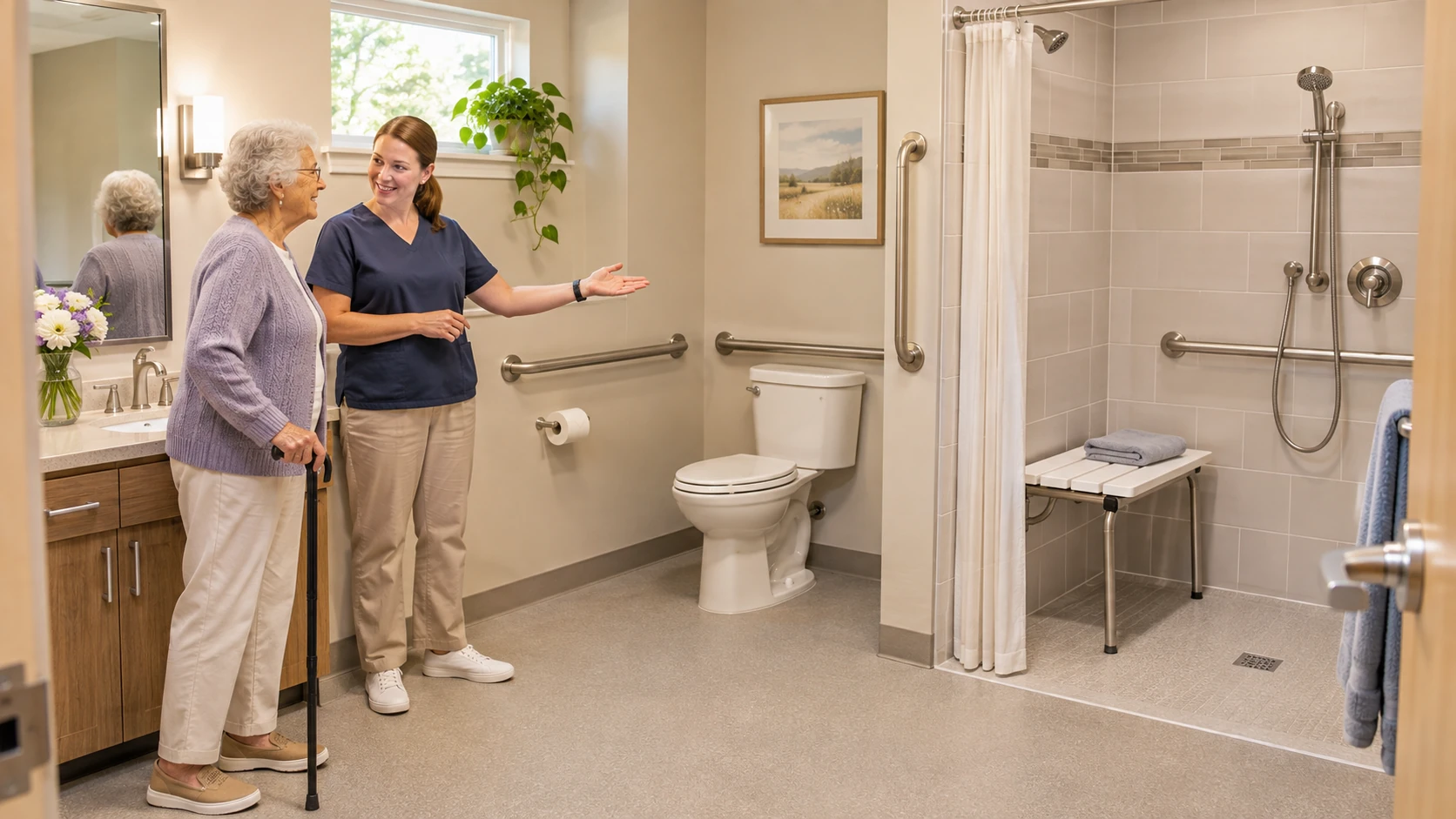
A well-designed community may offer step-free routes, handrails, accessible bathrooms and systems for requesting assistance. This can make daily movement and personal care easier. No design eliminates all fall risk, however. Ask whether the person’s walking aid, wheelchair or transfer requirements can be safely accommodated.
3. Opportunities for companionship
A shared dining room, small-group activities, gardens or communal lounges can create natural opportunities to meet other people. For someone who lives alone and rarely gets out, the chance to join a conversation without arranging transportation may matter more than an elaborate activity calendar. The key is whether the activities suit the resident’s interests, hearing, language and mobility needs. Our senior mental health guide explores social connection and emotional well-being.
4. Relief from household responsibilities
Meals, laundry, housekeeping and maintenance may be organized by the community. This can ease the demands of managing a home. Compare the actual services included in the base price: personal laundry, linen changes and cleaning frequency may be treated differently.
5. Support for meals and medication routines
Regular meal opportunities and agreed medication assistance may make daily routines easier to maintain. Confirm whether the kitchen can accommodate allergies, prescribed diets and swallowing needs. Ask who oversees medication administration, what happens when a dose is missed and whether the resident can self-administer if assessed as safe.
6. Transport and help accessing services
Some communities arrange trips to shops or medical appointments and help coordinate with outside providers. This can be valuable to someone who no longer drives. Ask about wheelchair-accessible vehicles, booking requirements, fees, escorts and whether appointments outside the usual route or hours can be supported.
7. A different role for family caregivers
Moving may reduce the amount of hands-on care relatives provide, giving them more time for visits and their own responsibilities. Family involvement can remain important: someone may still need to track changes, accompany the resident to appointments, manage bills or communicate concerns. The goal is sustainable support, not to withdraw family connection.
7 disadvantages of assisted living
1. Monthly fees can be difficult to sustain
Housing, meals and care services can be expensive, and the starting price may exclude the help the resident actually needs. A person who needs increasing assistance may move into a higher pricing tier. Request a written assessment and a complete monthly estimate before agreeing to a contract.
2. Less familiarity and personal control
Leaving a familiar home can mean losing a garden, neighborhood, kitchen or daily routines. Residents may encounter scheduled meals, rules about pets or visitors and unfamiliar staff. Ask how the community protects privacy, allows residents to personalize their space and accommodates personal choices. A move does not have to mean giving up all independence. If the move could separate someone from a beloved dog, see our guide to retirement homes for dogs and alternative care arrangements.
3. Staffing and care quality vary
Two communities with similar apartments and amenities can provide very different care experiences. The number of residents needing help, staff training and overnight coverage all matter. Rather than judging by the lobby or price, ask for the actual staffing arrangements on each shift and how the community responds when multiple residents need help at once.
4. Medical and nursing services have limits
General assisted living is not designed to replace a hospital or continuous skilled nursing. Some providers can arrange visiting nurses or other clinical services, but others cannot accommodate complex care. A person who needs frequent clinical assessment, extensive transfer assistance or specialized dementia support should be assessed before admission, not after a crisis.
5. Shared living may not fit everyone
A person who values quiet, enjoys solitary hobbies or has a strong preference for familiar surroundings might dislike communal routines. Privacy, noise, roommate arrangements and access to private outdoor space can be important. Ask the older adult directly what would make a typical day enjoyable.
6. Loneliness can persist after a move
Social activities are opportunities, not guarantees. Hearing impairment, grief, depression, cognitive changes or difficulty joining groups may make connection harder. A resident who becomes withdrawn deserves attention and support rather than pressure to attend activities. Arrange a clinical review if there are persistent or new concerning mood changes.
7. Changing care needs may require another move
A community that can manage someone’s needs today might not be able to do so in two years. Ask how reassessments work, what the highest supported care level is, and under what conditions the residence can terminate the agreement. Confirm the notice and appeal or grievance arrangements under local rules. A verbal assurance that someone can stay forever is not a substitute for a clear contract.
How much does assisted living cost?
The 2025 CareScout Cost of Care Survey, published March 2, 2026, reported a U.S. national median of $6,200 per month, or $74,400 per year for assisted living. This is a national survey benchmark, not a guaranteed price or an individual assessment. Local rates and care needs can make an actual bill much higher or lower.
Compare the full monthly price
Request separate written amounts for the apartment, personal care, medication services, transport, supplies, meals outside the standard plan and any other mandatory or optional fees. Ask which services are bundled so you do not count them twice. Identify deposits, community fees and moving costs separately.
For example, imagine two communities offering equivalent assessed care. Community A advertises a $4,400 monthly base rate; community B advertises $5,300. After adding their hypothetical care and other monthly charges, A costs $6,050 and B costs $5,850. The cheaper advertised apartment would actually cost $200 more each month, or $2,400 more over a year, before one-time charges.
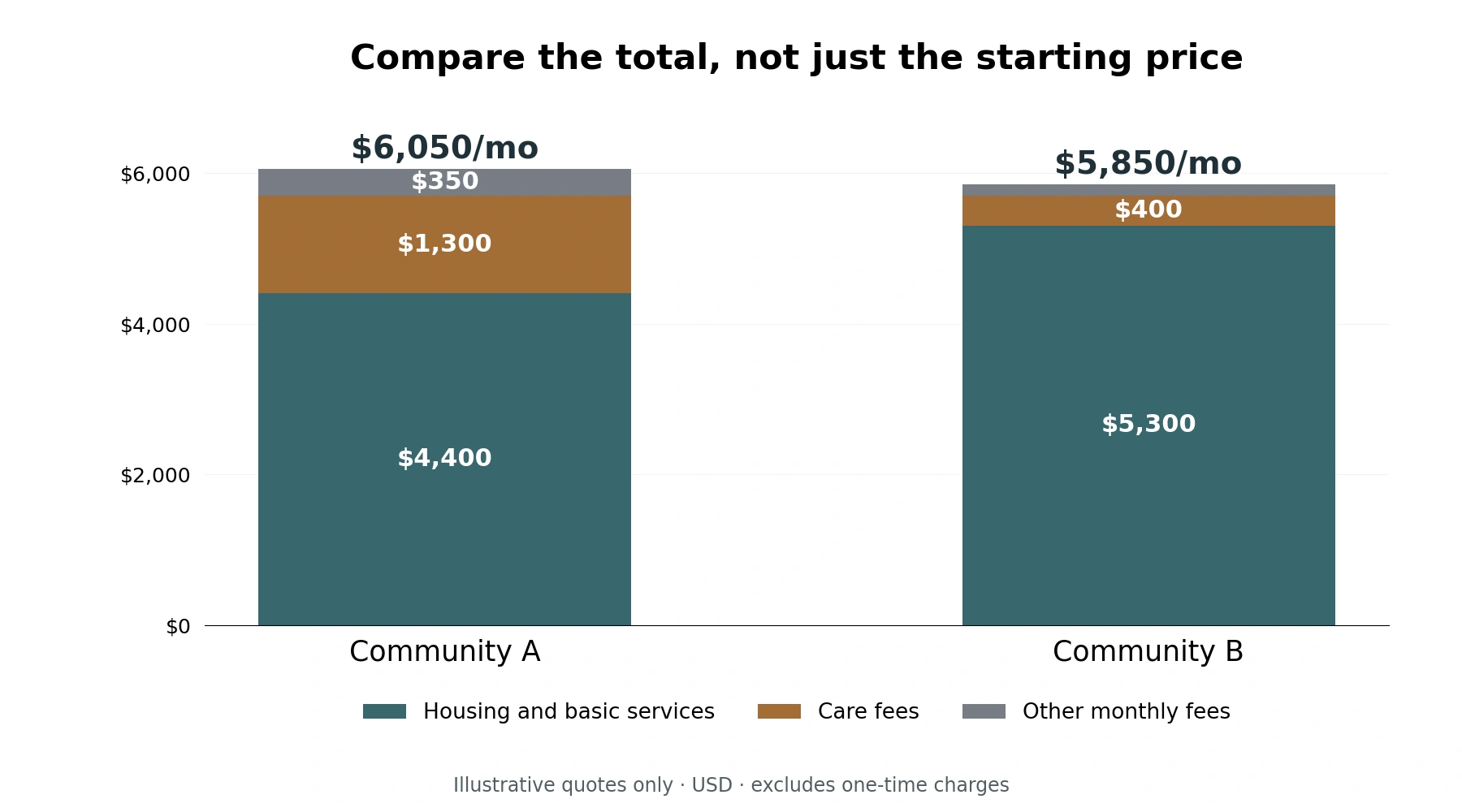
Before choosing, ask for a second quote based on a plausible future care increase. If a new care tier adds $750 per month, it adds $9,000 to a full year’s expenses. This is only an illustration; ask the provider for its actual reassessment rules and charges. Include a contingency for future rate changes, and review the plan with a qualified financial or benefits adviser if affordability is uncertain.
Does Medicare or Medicaid pay for assisted living?
In the U.S., Medicare generally does not cover long-term custodial care, including assisted living room and board. Separately eligible medical services, such as certain home health or hospice services, may be covered while a person lives there. Do not assume those benefits will pay for the residence itself.
Medicaid may cover qualifying support services in participating settings, depending on state rules and individual eligibility; it generally does not fund assisted living room and board under the relevant home- and community-based services arrangements. Some programs have enrollment limits. Confirm with the state program and community whether the specific residence participates and which costs remain the resident’s responsibility.
Private resources, eligible long-term care insurance benefits and some veterans’ benefits may help. Ask for coverage confirmation in writing. A community accepting Medicaid for some residents does not mean it accepts every applicant or that someone can remain there after their savings run out.
When is assisted living the right choice?
Start with the person’s goals and observed daily needs. A care assessment can identify what has changed, whether reversible health problems are involved and what level of support can be safely provided. These examples are prompts for a discussion, not a diagnostic or admission scoring tool.
| Situation | What to explore |
|---|---|
| Help with dressing, meals or bathing is needed most days. | Assisted living or scheduled home care, depending on preferences and available support. |
| The person manages personal care but wants fewer chores and more social contact. | Independent living, senior programs or home support may be sufficient. |
| Someone needs help repeatedly overnight. | Assess the type and frequency of help; verify overnight capacity and consider more intensive care if needed. |
| Unsafe wandering, distress or major cognitive changes. | Clinical assessment and dementia-capable services matched to individual needs. |
| Complex or unstable health needs. | Professional assessment of skilled nursing or other clinical care options. |
A sudden change is different from a gradual loss of independence. New confusion, stroke symptoms, severe breathing difficulty, chest pain or a serious injury may need urgent emergency care. Do not treat a sudden medical crisis as proof that a permanent move is required. Arrange assessment and a safe interim care plan first.
Alternatives to assisted living
Moving is not the only way to receive support. Compare options according to the person’s care requirements, the hours when help is needed and the ability to sustain the arrangement.
- Aging at home: A combination of home care aide services, home modifications, meals and transport can preserve familiar surroundings. Confirm coverage during gaps and overnight.
- Independent living: Housing with social and practical conveniences may suit someone who does not require routine hands-on personal care. Check whether outside care can be arranged if needs change.
- Adult day services: Daytime supervision and activities can support a person living at home and give caregivers a break, but do not cover overnight needs.
- Memory care: Dementia-specific residential services may be suitable when general assisted living cannot provide appropriate supervision and support. Capabilities vary.
- Nursing home or skilled care: Explore when more extensive nursing or functional support is required. Some people can receive appropriate private duty nursing care at home instead.
- Continuing care retirement community: A CCRC may offer multiple care levels. Review contract type, admission criteria, transfer rules and financial obligations.
A practical assisted living tour checklist
Visit with the older adult whenever possible. Try to see everyday operations, not just the prepared tour. A useful question is not simply “Do you provide this service?” but “How would you provide it for this specific person, including at night?”

| Ask or observe | Evidence to request |
|---|---|
| Who is present on each shift? | Staff roles, actual staffing levels, overnight arrangements, licensed nurse availability and how call requests are prioritized. |
| Can the resident’s assessed needs be met? | Written service plan with mobility, medication, personal care and supervision responsibilities. |
| What does the apartment support? | Bathroom access, unobstructed walking routes, call device location, space for the person’s mobility aid, evacuation plan. |
| What will a normal day look like? | Actual menu and activity calendar, quiet space, accessible activities, visits and personal routines. |
| What does the bill include? | Itemized quote, reassessment charges, rate-increase notices, deposits and refund terms. |
| How are problems resolved? | State license, available inspection or enforcement records, complaint procedure and contact details. |
| What if needs increase? | Retention and discharge rules, outside-provider policies, transfer planning and notice provisions. |
Check the state licensing agency’s records where available. A polished sales tour is not a substitute for independent information. In the United States, the Long-Term Care Ombudsman program can help residents and families understand complaint options and address concerns in covered residential settings.
Warning signs to take seriously
Ask for clarification or seek another option if the community cannot explain care limitations, refuses to provide clear prices, pressures you to sign before an assessment, or dismisses reasonable questions about staffing and safety. During visits, concerning patterns may include unanswered requests for help, repeated missed care or residents expressing fear of staff. One observation is not proof of neglect; investigate promptly and take resident concerns seriously.
If there is suspected abuse or neglect, prioritize the resident’s safety, document factual observations, and contact the appropriate licensing or protective agency or ombudsman. Call local emergency services if someone is in immediate danger.
How to make the transition with dignity
If the older adult can make an informed choice, involve them directly and respect their decision. Relatives may disagree, but family concern alone does not establish authority to force a move. For questions about legal decision-making, see our guide to whether someone can be forced into a nursing home and seek local legal advice where needed.
- Before the move: agree on what matters most, including daily routines, meaningful possessions, privacy, pets, friends and family visits.
- During the first week: review the service plan and medication list with authorized staff, make familiar items accessible and agree on how concerns will be communicated.
- After the first month: ask the resident what is working, review any missed or changed services, compare actual charges with the quote and arrange reassessment where necessary.
Adjustment has no fixed timetable. Persistent distress or an abrupt deterioration in health should not be dismissed as a normal part of moving. Ask the care team or clinician for advice and review whether the arrangement remains appropriate.
Frequently asked questions
What is the biggest disadvantage of assisted living?
For many households, the cost is the largest obstacle. For others, insufficient support, loss of familiar surroundings or the risk of another move matters more. Identify the most important trade-off for the particular person.
Can assisted living residents come and go freely?
Many residents can arrange their own outings and visits, but rules, individual care plans and applicable legal requirements vary. Ask about access, visitor policies and any proposed restrictions before signing. Restrictions should not be assumed to be appropriate merely because someone is older.
Is assisted living safer than living at home?
Not necessarily. Safety depends on actual support, accessibility, staff response and the person’s needs. A well-supported home can be appropriate for some people, while residential assistance may better meet other people’s needs. Compare specific arrangements rather than labels.
Can someone with dementia live in assisted living?
Sometimes. A dementia diagnosis alone does not determine the necessary setting. The person’s functional needs, supervision, behavior and medical care must be matched with the provider’s training and capabilities. Ask when specialized memory care or a higher level of nursing care would be needed. Our Lewy body dementia guide provides an example of variable support needs.
What happens if an assisted living resident runs out of money?
The answer depends on the contract, local law, available benefits and whether the community participates in assistance programs. Ask about the policy before admission and consult a qualified benefits or legal adviser early. Do not assume that Medicare or Medicaid will automatically cover the bill or guarantee continued residence.
The bottom line
The pros and cons of assisted living are best weighed against a real alternative, such as a well-supported home care arrangement. A suitable community should meet assessed care needs, respect the resident’s choices, provide transparent pricing and explain what happens if needs change. Start with the older adult’s priorities, request a written care and cost proposal, and compare more than one option before making a commitment.
Sources and editorial information
Sources consulted for this article include U.S. government coverage and oversight guidance, the original national cost survey and consumer care-selection resources. The fee comparison is a hypothetical example, not a quote or a prediction.
- U.S. GAO — Assisted Living Facilities: Information on Federal Spending and Medicaid Coverage (2026)
- Medicare — Long-term care coverage
- CareScout — 2025 Cost of Care Survey results (March 2026)
- Administration for Community Living — Long-Term Care Ombudsman
- CaringInfo — Choosing an assisted living facility
Prepared for Fairways Cottage by Jian Brant, publisher and editor, with AI-assisted research and drafting. No independent clinical, legal or financial professional review is represented. Read our editorial policy. This article provides general educational information, not individualized medical, legal or financial advice.
Share This Article: