

What is a Continuing Care Retirement Community (CCRC)?

A continuing care retirement community (CCRC), also called a life plan community, combines senior housing with contractual access to additional levels of care. Residents often start in independent living and may later receive assisted living or nursing care through the same provider or its partners. The aim is to reduce disruption when care needs change, not to guarantee that a resident will never need to move.
The defining difference from ordinary senior apartments is the continuing care agreement. It determines what care is available, how much it costs, who qualifies and what happens when a resident leaves. Some agreements prepay much of the cost of future care; others charge for it when needed. Two communities that look almost identical on a tour can therefore expose residents to very different financial risks.
This guide uses U.S. contract and funding terminology. Regulations and services vary by state and country. It is educational guidance, not personalized legal, financial or medical advice.
How does a continuing care retirement community work?
Many residents enter while they can manage everyday life with little assistance. They may live in an apartment or cottage, use shared facilities and maintain their own routines. If needs change, an assessment and the agreement guide whether support can be added in the current home or a transfer to a different setting is needed. North Carolina’s CCRC regulator describes the arrangement as residential housing with contractual access to health-related services; the exact legal definition varies by jurisdiction.
| Care setting | Typical purpose | What to verify |
|---|---|---|
| Independent living | Housing and everyday conveniences | Which meals, maintenance, transport and outside support are allowed |
| Assisted living | Help with daily personal care | Overnight staffing, medication support, mobility and transfer capacity |
| Memory care | Support tailored to cognitive impairment | Dementia training, supervision, admission and retention criteria |
| Nursing care | More extensive nursing or rehabilitation | Licensure, clinical capability, beds and long-term versus short-term care |
These are not compulsory stages. Someone may return to independent living after rehabilitation, need dementia support without nursing-home admission, or receive care from another provider. Memory care is not synonymous with skilled nursing. A campus may also have waiting lists, limited clinical capabilities or off-site arrangements. Ask what happens if the appropriate room is unavailable on the day it is needed. For families affected by Lewy body dementia, our guide to changing support needs in LBD may help frame questions for the care team. Community-based independent living specialists may help with skills and advocacy outside the retirement community setting.
For further context, see our guides to independent living for seniors and assisted living versus nursing homes.
CCRC contract types: Type A, B, C and other arrangements
Start with the written contract, not the label. Milliman’s actuarial overview describes several common models and their variations. The following table explains the general allocation of costs, not universal legal definitions.
| Agreement | How future care is paid for | Main question |
|---|---|---|
| Type A — extensive or life care | Prepayment of specified care through entrance and ongoing fees; covered transfers may produce little additional care charge | Which care, supplies, settings and fee changes are excluded? |
| Type B — modified | Limited included care days, discounted rates or other defined benefits | What happens when the allowance is exhausted? |
| Type C — fee for service | Care charged separately at applicable rates when used | Can you afford prolonged care at future prices? |
| Rental (sometimes Type D) | Usually smaller initial commitment; care typically charged separately | Does the lease actually provide priority or contractual access? |
| Equity or ownership | Purchase of a unit or interest; service and care fees follow separate terms | Who bears resale risk and what care rights come with ownership? |
Type A is not unlimited free healthcare
Even an extensive contract may permit ordinary annual fee increases, additional charges for excluded services, changes when one spouse transfers, and different fees for a different room category. Confirm the treatment of private-duty assistance, prescriptions, hospital care, transportation, therapies and specialist services. Ask the provider to show the relevant clause rather than relying on the phrase “life care.”
Type B and Type C: compare the actual benefit
A modified contract might offer a defined number of days at a reduced charge. Determine whether the allowance renews, whether days are counted per person or household, and whether temporary rehabilitation uses the same allowance as permanent care. A fee-for-service contract may cost less at entry but leaves more of the cost of care with the resident. Neither is inherently better for every household. LCS’s contract comparison provides additional examples of how the three principal models differ.
How much does a continuing care retirement community cost?
An entrance fee can be a major part of the price. CareScout’s October 2026 cost guide reports a broad illustrative range of $100,000 to $2 million for entrance fees and typical monthly fees of $2,000 to $4,000. These are published industry estimates rather than a representative 2026 national median or a quote for your household. Actual prices can fall outside them. Obtain a dated written schedule for the residence, number of occupants and contract you are considering.
Separate the entrance payment, recurring housing and service fees, additional care charges, and expenses that remain yours. An entrance fee normally should not be assumed to purchase real estate. If a community offers an ownership arrangement, examine the title or membership rights and resale conditions separately.
A worked example: compare ten-year cash payments
Imagine two otherwise comparable contracts for one resident. Type A requires $300,000 upfront and $5,000 monthly, including the specified nursing care. Type C requires $150,000 upfront, $3,500 per month while independent and a total of $9,000 monthly when receiving nursing care. These are invented prices for arithmetic only, not estimated care needs or actual provider prices. Assume no refunds, inflation, extra charges or investment earnings.
| Ten-year scenario | Type A | Type C |
|---|---|---|
| Independent throughout | $900,000 | $570,000 |
| 7 years independent + 3 years nursing | $900,000 | $768,000 |
| 4 years independent + 6 years nursing | $900,000 | $966,000 |
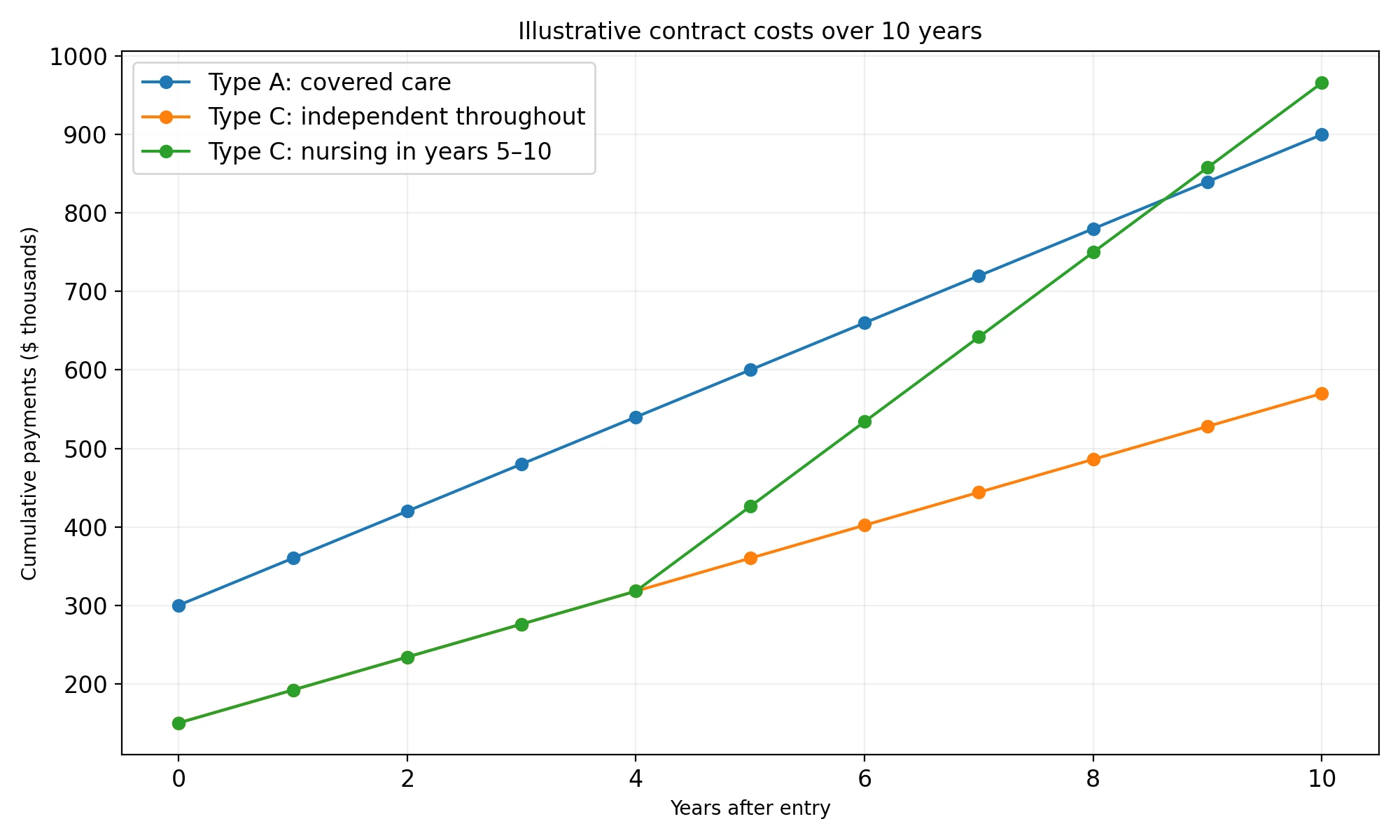
In this simplified model, the higher upfront Type A commitment costs more if little care is needed, while Type C costs $66,000 more in the six-year nursing scenario. Neither outcome predicts how long an individual will need care. Ask a qualified financial adviser to model annual fee increases, income changes, refunds, taxes, investment opportunity costs and multiple care scenarios using actual contract terms.
Stress-test the monthly fee
A $5,000 monthly charge growing by an illustrative 5% each year reaches about $6,381 after five increases, before separate care charges. Ask for historical increases and the current policy; the 5% assumption is not a prediction or cap. Include personal spending, insurance, medical costs, and emergency savings in the budget. Do not rely on a future refund to cover immediate care bills.
Entrance fee refunds: the percentage is only half the story
A 90% refundable $300,000 entrance fee could represent $270,000 before permitted deductions, but only if the conditions in the agreement are met. A refund may be delayed until a unit is reoccupied or another qualifying payment is received. Some contracts gradually reduce the refundable amount, while others use a fixed percentage or different formulas. A promise of refundability is not the same as cash available on demand.
- Ask for the exact refund formula and a worked example after one, five and ten years.
- Identify deductions, transfer costs, refurbishment charges and unpaid balances.
- Determine who receives a refund after death and when it is due.
- Ask whether a resale or reoccupancy condition can delay payment, and request actual refund waiting-time information.
- Ask an attorney to explain applicable protections, creditor priority and what happens if the operator becomes insolvent.
The California Department of Social Services explains that agreements and refund provisions can differ substantially and that regulatory approval is not a guarantee of performance. Rules in California should not be assumed to apply elsewhere.
Does Medicare or Medicaid pay for a CCRC?
In the United States, Medicare does not generally pay for long-term custodial care. It does not finance the ordinary entrance fee or monthly housing charge. Eligible medical services may be covered separately, including limited short-term skilled nursing facility care when coverage conditions are met. Being a CCRC resident alone does not qualify someone for those benefits.
Medicaid eligibility and provider participation depend on the state, the individual’s circumstances and the service. See Medicaid’s nursing facility coverage guide. Do not assume that exhausting savings ensures continued residence or that a CCRC entrance fee is exempt from eligibility calculations. Ask the state Medicaid agency and an elder-law attorney about the particular contract and whether the relevant care setting participates. Check long-term care insurance benefits directly with the insurer, including eligibility triggers, limits and exclusions.
Benefits and drawbacks of a CCRC
| Potential advantage | Trade-off |
|---|---|
| Continuity of relationships and surroundings | A transfer to another unit or site may still be necessary |
| Convenient meals, maintenance and social activities | Amenities may cost money even if rarely used |
| Planning for future care before a crisis | Admission may involve health and financial assessments |
| Potentially more predictable covered care charges | Large upfront commitment and annual fee increases |
| Partners may remain close if needs diverge | Separate accommodations and double charges may apply |
A CCRC may suit a person who wants community-based living and has the resources to make a long-term commitment. It may not fit someone who prefers remaining at home, needs a service the community cannot provide, or would have too little liquid savings left after the entrance payment. The person’s own priorities should guide the decision. Consider the pros and cons of assisted living and home care aide support as alternatives, not inferior choices.
What if one spouse needs care before the other?
Consider a hypothetical couple sharing a cottage. One develops a need for regular overnight support, while the other remains independent. A transfer may allow visits within the campus, but their costs and daily arrangements could change substantially. Request a written quote for both households during a temporary stay and a permanent transfer. Ask whether the original residence must be surrendered, whether a second-person fee continues and whether the couple may live together in a suitable care setting. Check what happens to the surviving partner’s contract and refund rights.
How to evaluate a CCRC before signing
Visit more than one community. Tour the actual residence and the higher-care settings, subject to resident consent and privacy. Speak with willing residents and the resident council. A pleasant dining room is worth considering, but so are the staff available at night, how complaints are addressed and whether services remain accessible when mobility changes.
| Request | Why it matters |
|---|---|
| Sample contract and all fee schedules | Establishes the actual legal commitments and exclusions |
| Current disclosure statement and audited financial statements | Helps identify obligations, reserves, debt and financial condition |
| Occupancy, refund backlog and actuarial information where available | Helps advisers examine whether future promises are financially sustainable |
| Recent fee-increase history and planned capital projects | Shows exposure to future charges and construction disruption |
| Care admission, transfer and discharge policies | Clarifies what happens during a change in health or a shortage of beds |
| Licenses and inspection or enforcement records | Helps verify the services the provider may deliver and its compliance history |
| Financial hardship and termination provisions | Clarifies the consequences of depleted assets and the availability of assistance |
The North Carolina Department of Insurance’s CCRC portal is an example of a state resource that publishes regulatory information and disclosures. Find the equivalent agency for the community you are considering. Nonprofit status, a bond rating or accreditation alone does not establish financial safety. Have an independent attorney and financial adviser review the documents before making an irrevocable commitment.
Five questions to get answered in writing
- If I need nursing care tomorrow and no bed is available, who arranges and pays for interim care?
- Which services trigger an additional fee, and can you show me an example monthly bill?
- If I move out or die, exactly when and how will the refund be calculated and paid?
- If the provider changes ownership or has financial difficulty, what protections are in place?
- If I can no longer afford the fees, what assistance or termination process applies, and what conditions must I satisfy?
Treat pressure to sign before obtaining the full agreement, unexplained charges, evasive answers about care availability and reluctance to provide required disclosures as reasons to investigate further. A missing document is not proof of misconduct, but unresolved material questions should delay a major financial commitment. For concerns about residential care, the Long-Term Care Ombudsman Program can help identify appropriate advocacy resources; contract disputes may require independent legal assistance.
Frequently asked questions
Is a CCRC the same as a retirement home?
Not necessarily. A retirement community may offer housing alone. A CCRC typically provides defined access to additional care under an agreement.
Do you have to be healthy to enter a CCRC?
Many independent-living entry programs assess health and finances. Criteria differ; some providers accept direct admissions into a care setting under different terms.
Can I leave a continuing care retirement community?
Yes, subject to the agreement and applicable law. Notice periods, fees, refunds and relocation arrangements should be reviewed before entry.
Is Type A always the best contract?
No. Its value depends on prices, included services, care needs, financial resources and the provider’s ability to honor the agreement.
Will I ever have to move again?
Possibly. A move within the campus, temporary placement elsewhere or permanent transfer may be needed depending on clinical needs, availability, contract rights and provider circumstances.
The bottom line
A continuing care retirement community can be a valuable way to plan for changing needs, but the agreement matters as much as the campus. Compare multiple written offers, test the costs under different care scenarios and ask independent advisers to review the legal and financial commitments. Choose only when the daily lifestyle, care arrangements and financial risks make sense for the person who will live there.
Sources and editorial information
Prepared for Fairways Cottage editor Jian Brant with AI assistance. Sources consulted November 24, 2026. No independent legal, financial or clinical review is claimed. The examples are hypothetical and are not individual recommendations.
Share This Article: